Download
1 / 16
160 likes | 263 Vues
This guide delves into Mendelian genetics, focusing on key concepts such as alleles, dominant and recessive traits, and the laws of segregation and independent assortment. It covers Mendel's experiments with pea plants, yeast complementation studies, and the use of Punnett squares to predict offspring genotypes. You'll learn how homologous chromosomes may carry different alleles, and how phenotype ratios emerge from genetic crosses. Additionally, the implications of dominant alleles, test crosses, and blood type inheritance are explored, providing a comprehensive understanding of classical genetics.

E N D
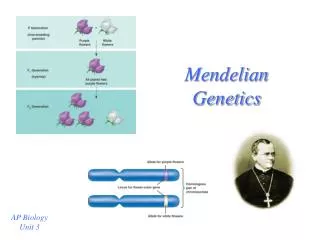
Mendelian Genetics AP Biology Unit 3
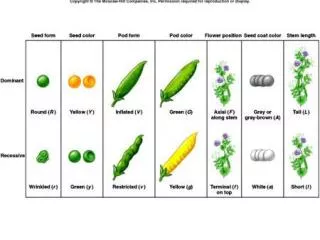
Mendel’s Experiments • Crossbred Pea Plants • P, F1, F2 generations
Alleles • Alleles are different (alternate) forms of a gene • How do alleles relate to homologous chromosomes? • Homologous chromosomes may contain different alleles
Yeast Complementation & Alleles • How did alleles play a role in the yeast complementation experiment? • Strains of yeast have different alleles • When mated, the a normal allele could complement a mutated allele • HA1 = mutated ade 1 allele , normal trp allele • HBT = normal ade1 allele, mutated trp allele
Dominant vs. Recessive Alleles • Dominant Allele • Determine phenotype if there is a copy present • Recessive Allele • Need 2 copies to determine phenotype
Law of Segregation • “Two alleles for a trait separate during gamete formation” • Gametes can have different alleles
Punnett Squares • Allow you to predict possible genotypes of offspring if parental genotypes are known • Phenotypes can be deduced from the genotypes
Phenotype Ratios • Characteristic possible phenotype ratios always occur • 2:2 (1:1) • 3:1 • 4:0 (1:0)
Test Cross • Suppose you have an organism with a dominant phenotype • You want to determine its genotype– PP or Pp? • Cross with a recessive phenotype to determine genotype = test cross
Law of Independent Assortment • “Pairs of alleles for a given trait segregate independently of other pairs of alleles for another trait” • Ex. YyRr can result in YR, Yr, yR, or yr • This only applies to two traits on different chromosomes (NOT LINKED)
Blood Type Alleles • Codominance = both IA and IB alleles are dominant • Multiple alleles (more than 2 alleles)
Practice Problem #1 • The Huntington’s disease allele is dominant (represented as “H”). • A husband’s genotype is Hh; a wife’s genotype is hh • Which of them will develop Huntington’s disease • What are the possible genotypes for their children? What are the chances their child will have Huntington’s Disease?
Answer • The husband will develop Huntington’s Disease • Children could be Hh (50% chance) or hh (50% chance) • So there is a 50% chance their child will have Huntington’s disease.