The Importance of Annotating: Enhance Your Reading Experience and Understanding
Why should readers annotate texts? Annotating helps deepen comprehension and engagement with the material. By using symbols like 'Y' (Yes), 'N' (No), 'F' (Fact), and 'O' (Opinion), readers can track their reactions and thoughts directly on the text. This active reading strategy encourages reflection on the author's main ideas, noteworthy facts, and the tone or purpose compared to other works. Reflect on your own habits regarding waste and consider practical actions to reduce it. Get ready to grab your pen and start enhancing your reading journey!

The Importance of Annotating: Enhance Your Reading Experience and Understanding
E N D
Presentation Transcript
Time to read • Who remembers what it means to ANNOTATE? • WHY should a reader ANNOTATE while he / she reads? • GRAB a pen / pencil and be ready to ANNOTATE while you read.
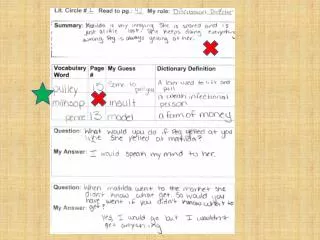
Annotating symbols • Y = Yes, I agree with this. This sounds about right. • N = No, I don’t agree with this. There is something wrong here. • F = I see a FACT here. • O= I see an OPINION here. • ! = Wow! I find this really surprising. • ?? = Huh? I am confused by this. • J = This is funny. • * = I bet that this is an important piece to remember. • W = This is weird, creepy, or unusual.
Complete the following questions on the back side of your article. • What does the author MOST WANT you to know in this article? (What is the main idea)? • List 3 – 4 facts / statistics / or images that got your attention for some reason. • How is the TOPIC of this article like or different than the poem we read yesterday? • How is the TONE of this article like or different than the poem we read yesterday? • How is the PURPOSE of this article like or different than the poem we read yesterday?
THINK: What are areas in your life that you do a good job in watching the amount of garbage you create or resources you waste? What are areas in your life that you know you do NOT do a good job with these things. List 3 SPECFIFIC, PRACTICAL things you could do to lessen your garbage / wastefulness.