Exploring Earth's Diverse Biomes: From Aquatic to Tundra
10 likes | 146 Vues
This article delves into the rich variety of Earth's biomes, including aquatic habitats, deserts, jungles, and more. We will explore the unique characteristics of each biome, such as the climate, biodiversity, and the distinctive flora and fauna that inhabit them. Learn about the importance of estuaries, the challenges of desert ecosystems, and the role of freshwater habitats. Discover how mountain and tundra biomes differ in elevation and climate, and understand the significance of tropical rainforests and savannas in maintaining ecological balance.


Exploring Earth's Diverse Biomes: From Aquatic to Tundra
E N D
Presentation Transcript
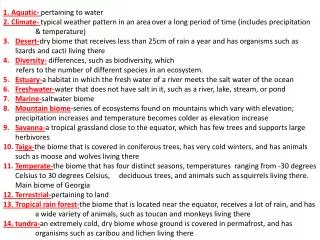
1. Aquatic- pertaining to water • 2. Climate- typical weather pattern in an areaover a long period of time (includes precipitation & temperature) • Desert-dry biome that receives less than 25cm of rain a year and has organisms such as lizards and cacti living there • Diversity-differences, such as biodiversity, which • refers to the number of different species in an ecosystem. • Estuary-a habitat in which the fresh water of a river meets the salt water of the ocean • Freshwater-water that does not have salt in it, such as a river, lake, stream, or pond • Marine-saltwater biome • Mountain biome-series of ecosystems found on mountains which vary with elevation; precipitation increases and temperature becomes colder as elevation increase • Savanna-a tropical grassland close to the equator, which has few trees and supports large herbivores • Taiga-the biome that is covered in coniferous trees, has very cold winters, and has animals such as moose and wolves living there • Temperate-the biome that has four distinct seasons, temperatures ranging from -30 degrees Celsius to 30 degrees Celsius, deciduous trees, and animals such assquirrels living there. Main biome of Georgia • 12. Terrestrial-pertaining to land • 13. Tropical rain forest-the biome that is located near the equator, receives a lot of rain, and has a wide variety of animals, such as toucan and monkeys living there • 14. tundra-an extremely cold, dry biome whose ground is covered in permafrost, and has organisms such as caribou and lichen living there