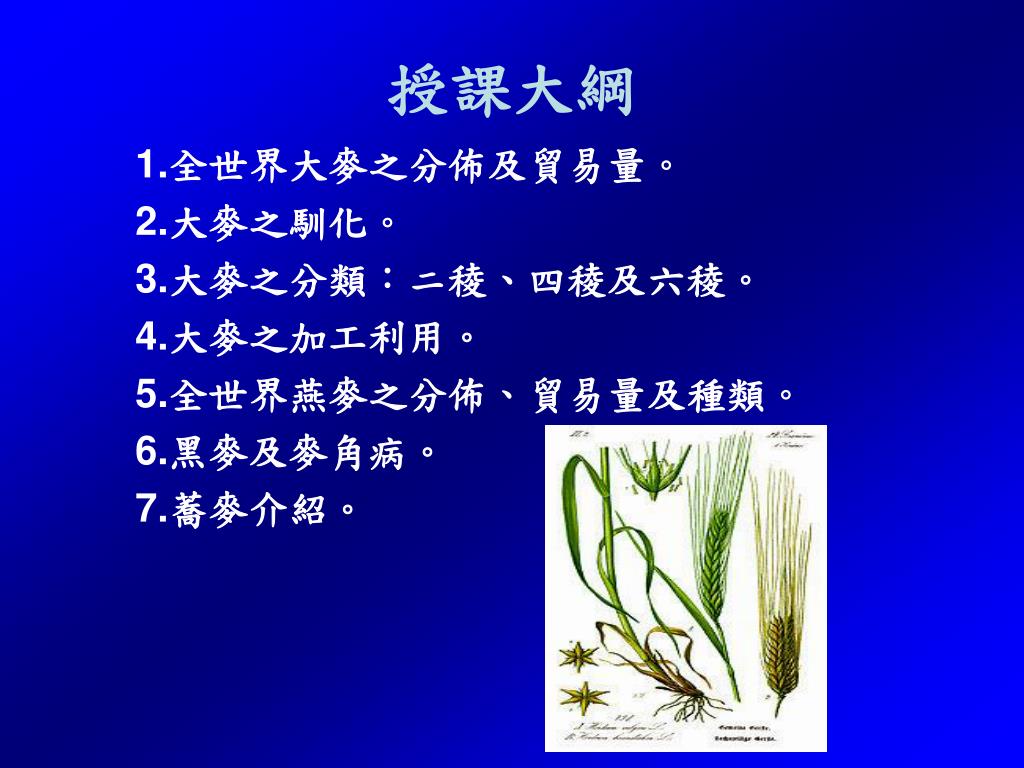
Une image / un lien ci-dessous est fourni (tel quel) pour télécharger la présentation
Politique de téléchargement : le contenu du site vous est fourni TEL QUEL pour votre information et votre usage personnel ; il ne peut être vendu, concédé sous licence ni partagé sur d’autres sites sans l’accord de son auteur.Le contenu vous est fourni TEL QUEL, pour votre information et votre usage personnel uniquement.Téléchargez la présentation en cliquant sur ce lien.Lors du téléchargement, si vous ne parvenez pas à télécharger une présentation, l’éditeur a peut-être supprimé le fichier de son serveur.Pendant le téléchargement, si vous ne parvenez pas à obtenir une présentation, le fichier a peut-être été supprimé par l’éditeur.
Suggested readings:: • Daisuke Saisho and Kazuyoshi Takeda (2011) Barley: emergence as a new research material of crop science. Plant Cell Physiol. 52(5): 724–727. 2. Byung-Kee Baik, Steven E. Ullrich. (2008) Barley for food: Characteristics, improvement, and renewed interest. Journal of Cereal Science 48: 233–242.
Barley was one of the first agricultural domesticates together with wheat, pea (Pisum sativum), lentil (Lens culinaris), goats (Capra aegagrus hircus), sheep (Ovis aries), and cattle (Bos taurus) dating from about 10,000 years ago in the Fertile Crescent of the Middle East. Barley was presumably first used as human food but evolved primarily into a feed, malting and brewing grain due in part to the rise in prominence of wheat and rice. In recent times, about two-thirds of the barley crop has been used for feed, one-third for malting and about 2% for food directly. However, throughout its history, it has remained a major food source for some cultures principally in Asia and northern Africa.
Barley was recognized early on as a hearty tasting, high-energy food. For example, the Roman gladiators were known as ‘‘hordearii’’ or ‘‘barley men’’ for eating barley to give them strength and stamina. The major advantage of incorporating barley into various food products and their consumption stems from barley’s potential heath benefits. The effectiveness of barleyb-glucans (b-葡聚醣)in barley food products in lowering blood cholesterol, and glycemic index is widely accepted. Barley is a rich source of tocols, including tocopherols and tocotrienols, which are known to reduce serum LDL cholesterol through their antioxidant action . The recent approval of soluble barley b-glucan health claims by the Food and Drug Administration of the USA for lowering blood cholesterol level could further boost food product development from barley and consumer interest in eating these food products.
Barley is one of the most genetically diverse cereal grains. Barley is classified as spring or winter types, two- row or six-row, hulled or hulless by presence or absence of hull tightly adhering to the to grain, and malting or feed by end-use type. Based on grain composition, barley is further classified as normal, waxy or high amylose starch types, high lysine, high b-glucan, and proanthocyanidin-free. Barleys of different classes often differ widely in physical and compositional characteristics and accordingly have different processing properties and end-use quality.
(A) Two-rowed spike. (B) Six-rowed spike. (C–G) One central and two lateral spikelets at a rachis node. (C) Ethiopian landrace var. deficiens; rudimentary lateral spikelets (Vrs1.t). (D) Two-rowed cultivar var. distichon; sterile lateral spikelets (Vrs1.b). (E) Wild barley var. spontaneum; sterile lateral spikelets (Vrs1.b). (F) Wild barley var. proskowetzii; short-awned or tip-pointed lateral spikelets (Vrs1.p). (G) Six-rowed cultivar convar. vulgare; fully fertile and awned lateral spikelets (vrs1.a). (H and I) Staminate floret of lateral spikelet (H) and hermaphroditic floret (I) in central spikelet in Vrs1.b two-rowed cultivar (D).
Grain is used in soups, cereals, bread • 2. Malted Barley (Barley soaked in water, sprouted, • produces amylases which breaks down the starch to • maltose) used in producing: • Beer • Whiskey • 3. Maltose made from malted barley, used in producing: • Candy • Baked goods • Cereals