Post-War America: Truman's Domestic Agenda and Eisenhower's Economic Growth
After World War II, America faced challenges in transitioning to a peacetime economy, including inflation and strikes driven by rising demand. Truman's domestic agenda aimed to address these issues through initiatives like the GI Bill, which supported veterans, and proposed measures for civil rights and full employment. Though many proposals were blocked by Congress, Truman secured a surprising reelection victory in 1948. Eisenhower continued the economic boom by appointing business leaders, cutting taxes, and passing the Federal Highway Act, leading to a prosperous 1950s.


Post-War America: Truman's Domestic Agenda and Eisenhower's Economic Growth
E N D
Presentation Transcript
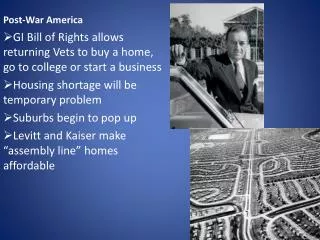
Truman and Eisenhower • Return to a peacetime economy after the war caused problems: • Rising demand Inflation Strikes • GI Bill: boosted the economy by giving loans to veterans to help them start businesses, buy homes, and attend college
Truman Domestic Agenda • Despite Democratic losses in 1946, Truman pursued an aggressive domestic agenda: • Increase in minimum wage • Expansion of social security • Program to ensure full employment • National health insurance • Civil Rights bill
Truman • With Congress dominated by Republicans and conservative Democrats, however, most of Truman’s proposals were defeated. • Taft-Hartley Act approved over Truman’s Veto • Truman ran for re-election in 1948 • Truman ran an aggressive campaign against the Republican Do-Nothing Congress and won a surprise victory.
Truman • After his reelection, Truman proposed the Fair Deal, an extension of the New Deal, some of which Congress approved. • In 1952, with the war in Korea dragging on, Truman decided not to run again.
Eisenhower • Appointed several business leaders to Cabinet jobs and viewed business growth as vital to the nation. • Cut taxes and some federal spending. • Got the Federal Highway Act passed, which constructed the interstate highway system. • Extended social security and unemployment, and increased minimum wage.
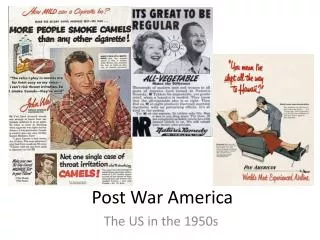
Eisenhower • By the time Eisenhower ran for reelection in 1956, the nation had completed the transition from a wartime to a peacetime economy, and the 1950s were turning into an extremely prosperous decade