Download
1 / 3
30 likes | 159 Vues
Explore the transformative scientific theories of the 20th century, including Einstein's theory of relativity and quantum mechanics. This period challenged traditional Newtonian views, proposing that time, space, and matter are interconnected in a complex continuum. Discover how pioneers like Marie Curie, Max Planck, and Werner Heisenberg reshaped our understanding of energy, at the atomic level, and the inherent uncertainties of the universe. Learn how these theories emphasize the speculative nature of scientific descriptions and the evolving nature of reality.

E N D
20th Century Mindset - Physics Kagan Ch. 24
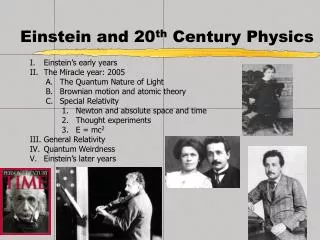
theory of relativity = time and space exist together in a combined continuum scientific theories should be considered hypothetical What are they talking about? science = “as if” descriptions discovered uranium • Ernst Mach, The Science of Mechanics, 1883 • Henri Poincare • Hans Vaihinger, 1911 • Wilhelm Roentgen, Dec. 1895 • Henri Becquerel, 1896 • Marie Curie, 1911 • J. J. Thompson • Ernest Rutherford, 1902 • Max Planck, 1900 • Albert Einstein, 1905 • Werner Heisenberg, 1927 uncertainty principle – pattern of electron can’t be predetermined quantum theory of energy realizes the immense potential of energy created through the breakdown of radioactive elements developed the theory of the electron X-ray = energy can penetrate seemingly solid objects discovered radium science = a description of the scientist’s perceptions
New Physics • Newtonian Physics – back in the good ol’ days • Universe = machine in which time, space and matter were objective realities • Thermodynamics • Marie & Pierre Curie; Henri Becquerel; J.J. Thompson – atoms radiate own energy – electron & protons = atom • Max Planck – quantum theory = questions subatomic realm of atom: Is atom the building block of the material world? • Albert Einstein “The Electro-Dynamics of Moving Bodies”, 1905 = relativity theory (E=mc2) time and space are relative to the observer and matter is just another form of energy • Universe = uncertainty (Heisenberg, 1927) • Not as ordered as we thought • Contains other forces at work that were previously unknown • Often defies reason in its complexity