Understanding Electron Energy in Relativity: Equations and Errors
50 likes | 150 Vues
Learn about electron energy in relativity, rest energy calculations, kinetic energy equations, and error percentages. Understand the relationship between total energy, rest energy, and kinetic energy. Improve your knowledge of fundamental physics concepts.


Understanding Electron Energy in Relativity: Equations and Errors
E N D
Presentation Transcript
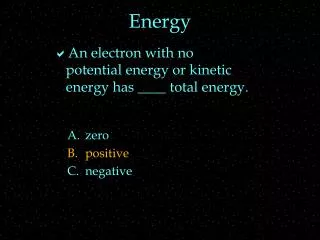
Energy • An electron with no potential energy or kinetic energy has ____ total energy. • zero • positive • negative
How fast? • A particle with mass ___ travel at speed c. • Light ___ travel at speed c. • can, can • cannot, cannot • can, cannot • cannot, can
Energies • Which of the following is true? • A particle’s rest energy cannot be greater than its kinetic energy. • A particle’s kinetic energy cannot be greater than its rest energy. • A particle’s kinetic energy cannot be greater than its total energy. • More than one of the above is true.
PAL Week 6 Wednesday In SI units, the mass of an electron is 9.11X10⁻³¹ kg. In relativity-friendly units, the mass of an electron is 511 keV/c2. 1. An electron has speed 15,000 km/s (which is 5% of c). • Find its rest energy in J. 8.199e-14 J • Find its total energy in J. 8.209e-14 • Find its kinetic energy in J, using the relativistic equation. 1.0268e-16 • Find the % error incurred due to using the non-relativistic kinetic energy equation. 0.19%
2. An electron has speed 0.4 c. • Find its rest energy in eV. 511 keV • Find its total energy in eV. 557.5 keV • Find its kinetic energy in eV , using the relativistic equation.46.5 keV • Find the % error due to using the non-relativistic kinetic energy equation. 12%