Understanding Power Management and Sleep Modes in Microcontrollers
40 likes | 146 Vues
Power management and sleep modes are essential for reducing energy consumption in microcontrollers. By ceasing clock operations on unused modules, devices can achieve low power states. For instance, quiescent CMOS operates with minimal energy, while power dissipation primarily arises from dynamic transitions. Various sleep modes like Idle, ADC Noise Reduction, Power-down, Power Save, Standby, and Extended Standby enable microcontrollers to operate efficiently in low-power conditions. Each mode has specific active components and wake-up triggers, allowing for optimized performance in energy-sensitive applications.


Understanding Power Management and Sleep Modes in Microcontrollers
E N D
Presentation Transcript
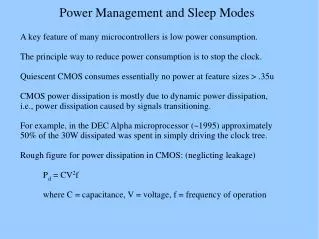
Power Management and Sleep Modes A key feature of many microcontrollers is low power consumption. The principle way to reduce power consumption is to stop the clock. Quiescent CMOS consumes essentially no power at feature sizes > .35u CMOS power dissipation is mostly due to dynamic power dissipation, i.e., power dissipation caused by signals transitioning. For example, in the DEC Alpha microprocessor (~1995) approximately 50% of the 30W dissipated was spent in simply driving the clock tree. Rough figure for power dissipation in CMOS: (neglicting leakage) Pd = CV2f where C = capacitance, V = voltage, f = frequency of operation
Power Management and Sleep Modes To save power in the AVR: cut off the clock to unused modules The MCU Control Register holds the power management settings. MCU Control Register sleep enable: if set, the MCU will enter sleep mode when the SLEEP instruction is executed SM2 SM1 SM0 0 0 0 Idle 0 0 1 ADC noise reduction 0 1 0 Power Down 0 1 1 Power Save 1 0 0 Reserved 1 0 1 Reserved 1 1 0 Standby 1 1 1 Extended Standby
Power Management and Sleep Modes Sleep Modes: Idle Mode: -Stopped: CPU, Flash memory -Running: SPI, USART, Comparator, ADC, TWI, TCNT0-3, Watchdog -Wakeup: external and internal interrupts ADC Noise Reduction Mode -Stopped: All above plus the I/O clocks -Running: ADC, TWI, TCNT0, Watchdog -Wakeup: external and internal interrupts Power-down Mode: -Stopped: All the above plus the external oscillator -Running: External interrupts, TWI address match, Watchdog -Wakeup: Watchdog, or brown out reset, external interrupt
Power Management and Sleep Modes Sleep Modes: Power Save Mode: (identical to Power-down, except:) -Running: TCNT0 also if clocked externally (asynchronous mode) -Wakeup: can also wakeup from TCNT0 interrupts Standby Mode: (identical to Power-down except:) -Running: External crystal clock oscillator still running -Wakeup: just like Power-down, except wakes up in 6 clock cycles Extended Standby Mode: (identical to Power-save except:) -Running: External crystal clock oscillator still running -Wakeup: just like Power-save, except wakes up in 6 clock cycles