Understanding Insulating Concrete Forms: Advantages and Applications
This introduction to Insulating Concrete Forms (ICFs) by Joseph Lyman, Executive Director of ICFA, explores the structure, insulation, and finishing systems of ICF walls. ICFs provide 100% insulation with R-values between 18 and 22, creating a monolithic structure that supports efficient utilities and finishes. This durable construction resists concrete pressure during placement and significantly enhances acoustical performance, evidenced by improved classroom test scores. With a rich history in construction and applications in residential and commercial markets, ICFs are a smart choice for sustainability and safety.


Understanding Insulating Concrete Forms: Advantages and Applications
E N D
Presentation Transcript
Wall Functions Structure Insulation Finish Attachment Chase for utilities
Typical ICF Wall 100% insulation (R- 18 to 22) 100% monolithic structure Integral furring Fully insulated chase cavity
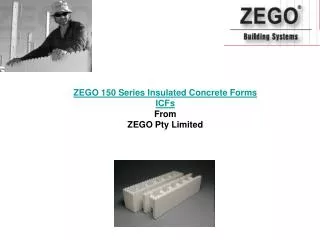
Components Face Shell 2 to 2.5” thick R- 18 to R-22 EPS or XPS Withstands internal pressure of concrete during placement
Components Form Tie Plastic or metal 6” to 12” o.c. Rebar saddles
Components Form Tie Face Tie face for attachment of finishes can be exposed or recessed
Components Reinforced Concrete Core 4”, 6” or 8” thick 10”+ in 2” increments Monolithic, 2,500 to 4,000 psi 6”slump 3/8” aggregate Rebar = 40 or 60 ksi
Quiet Comfort ICFs Have High STC Ratings 6” ICF wall = 57 Collaborative for High-Performance Schools study shows as noise is reduced inside classrooms, test scores increase
End Result Exterior shell with: Superior strength Thermal performance High R-value Thermal mass Virtually no thru wall infiltration Acoustical attenuation Disaster resistance Low Maintenance
ICF History • EPS was created by the German chemical company BASF in 1940s. • Werner Gregori created the foam ICF concept in the mid 1960’s as a foundation material, and submitted patents in 1966. • Currently, 70% of the ICF market is residential and 30% is commercial