Gravitational Waves: LIGO Status and Future Plans – Insights from Trieste Conference 2000
100 likes | 213 Vues
This summary details key developments presented by Barry Barish at the Trieste conference on gravitational waves, held from June 5-9, 2000. It reports progress on LIGO's seismic isolation systems, with installations completed at Hanford and Livingston observatories. Early quality issues were resolved, leading to successful testing of actuation systems. The document also outlines the readiness for LIGO's First Science Run in 2002 and the anticipation of significant sensitivity improvements by 2006, alongside discussions of astrophysical sources like supernovae and pulsars.


Gravitational Waves: LIGO Status and Future Plans – Insights from Trieste Conference 2000
E N D
Presentation Transcript
Gravitational Waves: A Challenge to Theoretical Astrophysics Trieste, 5-9 June 2000 LIGO Status and Plans Barry Barish 5 June 2000
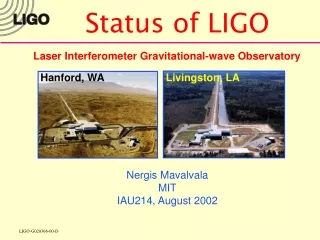
Seismic Isolation Systems Progress • production and delivery of components almost complete • early quality problems have mostly disappeared • the coarse actuation system for the BSC seismic isolation systems has been installed and tested successfully in the LVEA at both Observatories • Hanford 2km & Livingston seismic isolation system installation has been completed, with the exception of the tidal compensation (fine actuation) system • Hanford 4km seismic isolation installation is complete HAM Door Removal (Hanford 4km)
2km Fabry-Perot cavity • Includes all interferometer subsystems • many in definitive form; analog servo on cavity length for test configuration • confirmation of initial alignment • ~100 microrad errors; beams easily found in both arms • ability to lock cavity improves with understanding • 0 sec 12/1 flashes of light • 0.2 sec 12/9 • 2 min 1/14 • 60 sec 1/19 • 5 min 1/21 (and on a different arm) • 18 min 2/12 • 1.5 hrs 3/4 (temperature stabilize pre modecleaner)
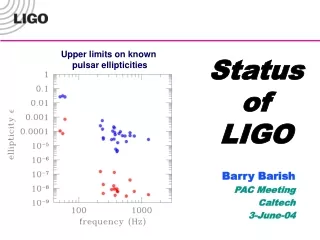
LIGOastrophysical sources • Pulsars in our galaxy • non axisymmetric: 10-4 < e < 10-6 • science: neutron star precession; interiors • narrow band searches best
Supernovae gravitational waves n’s light
Supernovae Gravitational Waves Non axisymmetric collapse ‘burst’ signal Rate 1/50 yr - our galaxy 3/yr - Virgo cluster
LIGOastrophysical sources SN1987A
Conclusions • LIGO I construction complete • LIGO I commissioning and testing ‘on track’ • Interferometer characterization underway • Data analysis schemes are being developed, including tests with 40 m data • First Science Run will begin in 2002 • Significant improvements in sensitivity anticipated to begin about 2006