Impact of World War II on Home Front Diversity
Explore how World War II influenced diversity on the home front, from the inclusion of minorities and women in businesses to the challenges faced by African-Americans. Learn about programs like the Bracero Program and the Great Migration, as well as significant events such as housing crises and riots. Discover the legal actions taken against internment and the economic costs of the war.

Impact of World War II on Home Front Diversity
E N D
Presentation Transcript
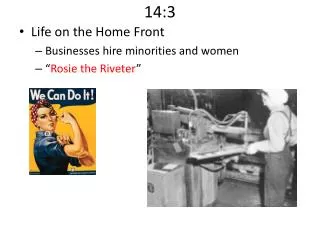
14:3 • Life on the Home Front • Businesses hire minorities and women • “Rosie the Riveter”
14:3 • African-Americans • Not hired by defense contractors • Demand changes • Roosevelt issues Executive Order 8802 (June, 1941) • First civil rights agency created by federal government since Reconstruction (1870s) • Forbids discrimination in defense work
14:3 • Bracero Program • bracero = “worker” • Government hires 200,000 Mexican workers • Harvest fruit and vegetables
14:3 • A Nation on the Move • Wartime economy creates millions of jobs • Many people move to south • Creation of the “Sunbelt”
14:3 • The Housing Crisis • War industries cities lack housing • Roosevelt creates National Housing Agency (NHA) • Provides prefabricated houses
14:3 • Great Migration starts up again • Massive movement of African-Americans north • Riots in some northern cities • Detroit, June 20, 1943 • Belle Isle • 25 African-Americans killed • 9 whites killed
14:3 • The Zoot Suit Riots • Southern California • Racism against Mexican-Americans • 2,500 soldiers and sailors attack Mexican-Americans
14:3 • Japanese-American Relocation • Many Americans on west coast turn against Japanese immigrants • Roosevelt allows military to designate parts of the country a “military zone” • People with Japanese ancestry forced into internment camps
14:3 • Legal Action Against Internment • Korematsu v United States (Dec 1944) • Supreme Court ruled internment was constitutional • Not based on race, but military urgency • Ex Parte Endo • Supreme Court ruled Americans cannot be held against their will • End of internment camps
14:3 • Cost of the War • $300 billion • more money than the government spent in total between 1787 to 1940 • Office of Price Administration (OPA) • “rationing” • Limiting use of goods and materials