Understanding the Climbing Abilities of Geckos: Hypotheses and Testing Methods
This lab explores the unique climbing abilities of geckos, common lizards in tropical regions known for their insect-hunting prowess and exceptional climbing skills. Students will consider what makes geckos such adept climbers, proposing at least 2-3 testable hypotheses and determining how to test them. Observations of gecko foot structure, including their ability to hang upside down on glass, will add data for hypothesis evaluation. The mechanics behind geckos' adhesion, rooted in van der Waals forces, will inspire discussions on bioengineering innovations.

Understanding the Climbing Abilities of Geckos: Hypotheses and Testing Methods
E N D
Presentation Transcript
The Gecko Problem Title your lab:
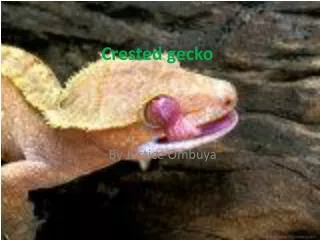
Do you know Geckos? • Common lizard in tropics • Insect hunters • Excellent climbers • Frequent human structures
On your paper record the question: 1)What makes geckos good climbers? 2) Propose at least 2-3 working hypotheses. 3) How could you test this? Be specific. State the criteria you would observe that would make you accept or reject your hypotheses
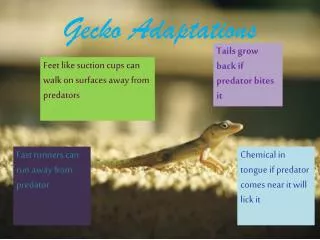
On glass upside down… 4) Does this new information or visual data change your hypotheses? How? Do you accept or reject your current hypothesis given the current data.
How do Gecko’s toes REALLY work????? Remember the electron cloud? • Contains Electrons (-) • Orbit around the nucleus • Constant motion! Like bumble bees on a leash? Or bees around a hive, they’re always moving!
Geckos: Van der Waals Forces at work • Exists between molecules: • 1. e- moving can cause unequal distribution of charge • Basically, wherever the electrons are, that region of the atomor molecule is more negative. • The result……. • 2. Really weakly + & - regions of molecules. Exist for fractions of seconds!
So surface area is key! More folds, more surface, more molecules, more van der Waals!!!!! 2. gecko feet
5) Summarize the way Geckos cling to surfaces. What are the bonds called? Are they strong or weak bonds? How can these bonds suspend the gecko?Hand in your gecko problems