Download
1 / 4
40 likes | 153 Vues
Effective aid delivery hinges on mutual accountability between donor and recipient countries, emphasizing genuine ownership and collaboration. Current contradictions include power imbalances and broken feedback loops that threaten domestic accountability. There is a pressing need for recipient countries to assert their voices and for better mechanisms to promote shared goals and reciprocity in commitments. This workshop aims to bridge the gap between global rhetoric and local realities by sharing experiences and identifying strategies to strengthen accountability in development partnerships.

E N D
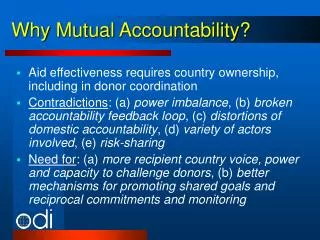
Why Mutual Accountability? • Aid effectiveness requires country ownership, including in donor coordination • Contradictions: (a) power imbalance, (b) broken accountability feedback loop, (c) distortions of domestic accountability, (d) variety of actors involved, (e) risk-sharing • Need for: (a) more recipient country voice, power and capacity to challenge donors, (b) better mechanisms for promoting shared goals and reciprocal commitments and monitoring
Civil Society Civil Society Parliament Parliament POLICY CYCLE - PRS - Budget Who ‘owns’ what? Who is accountable to whom? DONOR COUNTRIES RECIPIENT COUNTRIES POPULATION POPULATION DONOR AGENCY GOVERNMENT From consultation to influence From conditionality to accountability
Some definitions... • Paris Declaration • Donors and recipients carry out ‘mutual assessments of progress in implementing agreed commitments and more broadly their development partnership’ • DFID ‘working definition’ • ‘Two or more parties have shared development goals, in which each has legitimate claims that the other is responsible for fulfilling, and where each may be required to explain how they have discharged their responsibilities, and be sanctioned if they fail to deliver’
Why this workshop? • Weak link between global rhetoric and country-level experience • Interesting ongoing experiences in a few countries • Sharing ideas • Identification of important common factors, challenges and ways forward