Download
1 / 2
20 likes | 136 Vues
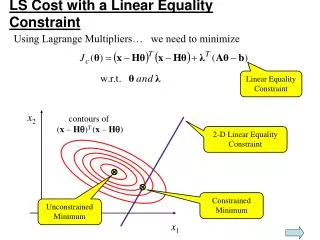
This study focuses on minimizing functions subject to linear equality constraints using Lagrange multipliers. It examines the contours of the function and analyses constraints in the form of linear equations, revealing how to derive relationships between variables. The method elucidates the interplay between constrained and unconstrained optimization, employing the gradient vector and its orthogonal properties to find stationary points. The approach provides a robust framework for understanding constrained optimization in two dimensions, emphasizing its applications in various optimization scenarios.

E N D
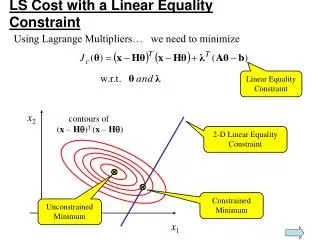
LS Cost with a Linear Equality Constraint Using Lagrange Multipliers… we need to minimize Linear Equality Constraint x2 contours of (x – H)T (x – H) 2-D Linear Equality Constraint Constrained Minimum Unconstrained Minimum x1
Ex.ax1 + bx2 – c = 0 x2 = (–a/b)x1 + c/b A Linear Constraint Ex. The grad vector has “slope” of b/a orthogonal to constraint line Constrained Max occurs when: Constrained Optimization: Lagrange Multiplier x2 f (x1,x2) contours Constraint: g(x1,x2) = C g(x1,x2) – C = h(x1,x2) = 0 x1