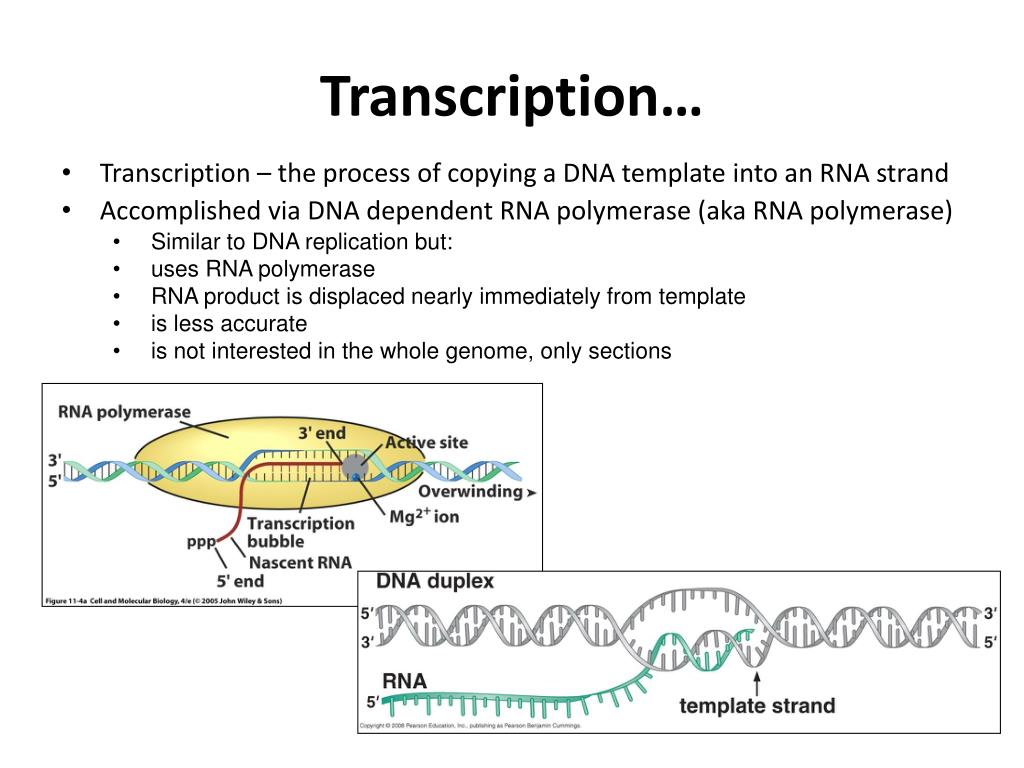
Transcription…. Transcription – the process of copying a DNA template into an RNA strand Accomplished via DNA dependent RNA polymerase (aka RNA polymerase) Similar to DNA replication but: uses RNA polymerase RNA product is displaced nearly immediately from template is less accurate
Une image / un lien ci-dessous est fourni (tel quel) pour télécharger la présentation
Politique de téléchargement : le contenu du site vous est fourni TEL QUEL pour votre information et votre usage personnel ; il ne peut être vendu, concédé sous licence ni partagé sur d’autres sites sans l’accord de son auteur.Le contenu vous est fourni TEL QUEL, pour votre information et votre usage personnel uniquement.Téléchargez la présentation en cliquant sur ce lien.Lors du téléchargement, si vous ne parvenez pas à télécharger une présentation, l’éditeur a peut-être supprimé le fichier de son serveur.Pendant le téléchargement, si vous ne parvenez pas à obtenir une présentation, le fichier a peut-être été supprimé par l’éditeur.
F I N
Plus de contenu associé
Transcription de la présentation
Transcription… • Transcription – the process of copying a DNA template into an RNA strand • Accomplished via DNA dependent RNA polymerase (aka RNA polymerase) • Similar to DNA replication but: • uses RNA polymerase • RNA product is displaced nearly immediately from template • is less accurate • is not interested in the whole genome, only sections
Transcription… • By the end of this series, you should be able to explain much of this animation • http://www.as.wvu.edu/~dray/219files/Transcription_588x392.swf
Bacterial RNA polymerase 50 - 100 nucleotides/sec • Most genes are transcribed simultaneously by numerous polymerases • Polymerase moves along DNA in 3' —> 5' direction • Complementary RNA constructed in ____ direction • RNAn + NPPP —> RNAn+1 + PPi
Transcription • How does the polymerase know where to start? • Promoter = the assembly point for the transcription complex • RNA polymerases cannot recognize promoters on their own - transcription factors • Transcription factors - enzymes have evolved to recognize (physically interact with) specific DNA sequences and with other proteins
Prokaryotic Gene Regulation • Preliminaries • DNA binding proteins • Minor vs. Major grooves • Bases are exposed in the grooves, providing binding sites • Each bp provides characteristic binding sites A – H acceptor, D – H donor, H – nonpolar H, M – methyl group
Prokaryotic Gene Regulation • Protein-nucleic acid binding • Most proteins to be discussed bind specific DNA sequences • Most commonly via α-helix insertion into major groove(s) • H donor/acceptors • + charge on helix interaction with phosphate backbone • Helix-turn-helix motif • 1st DNA binding domain identified
Transcription • Three-phase progression • Initiation – • Promoter recognition and binding • DNA melting • Transcript initiation • Elongation • mRNA produced • Termination • Polymerase and RNA released
Transcription • Bacterial transcription • Promoters • Core enzyme (α2ββ’ω) will begin transcription just about anywhere • σ provides specificity • Core + σ = holoenzyme • E. coli σ70 • σ70 promoters • 2 conserved sequences of 6 bp each • -10, -35
Transcription • Bacterial transcription • Promoters • Not all -10 and -35 sequences are identical • Consensus sequences • -35 – TTGACA • -10 - TATAAT
Transcription • Prokaryotic Transcription • Bacterial promoters are located just upstream of the RNA synthesis initiation site • The nucleotide at which transcription is initiated is called +1; the preceding nucleotide is –1 • DNA preceding initiation site (toward template 3' end) are said to be upstream • DNA succeeding initiation site (toward template 5' end) are said to be downstream
Transcription • Prokaryotic Transcription • One RNA polymerase with 5 subunits tightly associated to form core enzyme • Core enzyme minus sigma (σ) factor will bind to any DNA. • By adding σ, RNA pol will bind specifically to promoters (-10 & -35 sequences) • Transcription begins de novo • Requires stable interaction b/t base and template while second base is recruited
Transcription • Bacterial transcription • Three models of initial transcription • How to explain? • Transient excursion – Pol moves along DNA chain • Inchworming – • Scrunching – DNA pulled in • Experiments demonstrate: • Pol remains stationary on promoter • Pol subunits remain stationary relative to one another • Suggests that ‘scrunching’ is it • As DNA/RNA ‘piles up’ inside the polymerase, it creates pressure which contributes to forcing the polymerase off of the promoter
Transcription • Bacterial transcription • Several false starts before elongation begins • ≤ 9bp • ‘Escape’ - transcription of 10+ bp leading to elongation phase • 10+ bp too long to remain hybridized to tempate • Pol must break interactions with promoter and regulatory factors • σ ¾ linker must be ejected from RNA exit channel • ‘Scrunched’ DNA likely provides the energy to break pol-promoter interactions and dislodge σ
Transcription • Bacterial transcription • Termination • Rho (ρ) dependent • ATPase activity leads to translocation along transcript
Transcription • Bacterial transcription • Termination • ρ-independent • Two sequence elements • Inverted repeat • ~8 A:T stretch • Hairpin formation disrupts polymerase function • A:U binding weak
Transcription • Eukaryotic vs. Prokaryotic Transcription • Much of what we know is derived from studies of RNA pol II from yeast • 1. Seven more subunits than its bacterial RNA pol • 2. The core structure & the basic mechanism of transcription are virtually identical • 3. Additional subunits of eukaryotic polymerases are thought to play roles in the interaction with other proteins • 4. Eukaryotes require a large variety of accessory proteins or transcription factors (TFs)
Transcription • Eukaryotic transcription • Contrasts with prokaryotes • Three polymerases • RNA polymerase I (RNA pol I) - synthesizes the larger rRNAs (28S, 18S, 5.8S) • RNA polymerase II (RNA pol II)- synthesizes mRNAs & most small nuclear RNAs (snRNAs & snoRNAs) • RNA polymerase III (RNA pol III) - synthesizes various small RNAs (tRNAs, 5S rRNA & U6 snRNA) • Multiple general transcription factors (GTFs) • Additional regulatory elements (enhancers, chromatin modifiers, silencers, insulators, etc.) • RNA pol II – transcribes mRNA
Transcription • Eukaryotic transcription • RNA pol II core promoters • Four different sequence elements • TFIIB recognition element (BRE box) • TATA box • Initiator box (Inr) • Downstream promoter elements (DCE, DPE, MTE) • Various combinations in most Pol II promoters • All not necessary • Inr most common
Transcription • Eukaryotic transcription • Preinitiation complex formation • TBP component of TFIID • β sheet inserted into minor groove, bending DNA 80° • Specificity via phenylalanine chain intercalation on flanks of sequence
Transcription • Eukaryotic transcription • Preinitiation complex formation • TFIID – initial binding and recruitment • TFIIA – clamp • TFIIB - recruitment of pol II, may insert into RNA exit channel • TFIIF – stabilize complex, required for recruitment of TFIIE/H • TFIIE – recruit and regulate TFIIH • TFIIH – kinase • Largest GTF • Phosphorylates carboxy-terminal domain (CTD) of pol II • http://www.crocoduck.bch.msstate.edu/BCH4713/Transcription.wmv
RNA processing – mRNA • 5’ cap • The raw transcript will be immediately degraded in the cytoplasm so it must be marked and protected • Possible/known functions of 5’ cap • May prevent exonuclease digestion of mRNA 5' end, • Aids in transport of mRNA out of nucleus • Important role in initiation of mRNA translation
RNA processing – mRNA • mRNA processing – Splicing • Requires break at 5' & 3' intron ends (splice sites) & covalent joining of adjacent exons (ligation) • http://www.as.wvu.edu/~dray/219files/mRNASplicingAdvanced.wmv • Why introns? • Disadvantages – extra DNA, extra energy needed for processing, extra energy needed for replication • Advantages – modular design allows for greater variation and relatively easy introduction of that variation
RNA processing – mRNA • mRNA processing – Splicing • Splicing MUST be absolutely precise • Most common conserved sequence at eukaryotic exon-intron borders in mammalian pre-mRNA is G/GU at 5' intron end (5' splice site) & AG/G at 3' end (3' splice site)
RNA processing – mRNA • mRNA processing – Splicing • Sequences adjacent to introns contain preferred nucleotides that play an important role in splice site recognition
RNA processing – mRNA • mRNA processing – Splicing • Nuclear pre-mRNA (common) • snRNAs + associated proteins = snRNPs • snRNAs – 100-300 bp • U1, U2, U4, U5, U6 • 3 functions for snRNPs • Recognize sites (splice site and branch point site) • Bring these sites together • Catalyze cleavage reactions • Splicosome – the set of 5 snRNPs and other associated proteins • Summary movie available at: • http://www.as.wvu.edu/~dray/219files/mRNAsplicing.swf
RNA processing – mRNA • mRNA processing – Splicing • 1. U1 and U2 snRNPs bind via complementary RNA sequences • Note the A bulge produced by U2 • U2 is recruited by proteins associated with an exon splice enhancer (ESE) within the exon
RNA processing – mRNA • mRNA processing – Splicing • 2. U2 recruits U4/U5/U6 trimer • U6 replaces U1, U1 and U4 released • U5 binds to upstream exon
RNA processing – mRNA • mRNA processing – Splicing • 3. U6 catalyzes two important reactions • Cleavage of upstream exon from intron (bound to U5) • Lariat formation with A bulge on intron • Exons are ligated • U2/U5/U6 remain with intron
DNA/RNA Structure OH OH NB NB NB NB DNA RNA OH O OH OH P O C OH O P P P O O O C C C O OH OH
RNA processing – mRNA • mRNA processing – Splicing • http://www.crocoduck.bch.msstate.edu/BCH4713/ch13_group_II_introns.html • Several lines of evidence suggest that it is the RNA in the snRNP that actually catalyzes the splicing reactions • 1. Pre-mRNAs are spliced by the same pair of chemical reactions that occur as group II (self-splicing) introns • 2. The snRNAs needed for splicing pre-mRNAs closely resemble parts of the group II introns • Proteins likely serve supplemental functions • 1. Maintaining the proper 3D structure of the snRNA • 2. Driving changes in snRNA conformation • 3. Transporting spliced mRNAs to the nuclear envelope • 4. Selecting the splice sites to be used during the processing of a particular pre-mRNA
Transcription • Polyadenlyation • The poly(A) tail – 3' end of most mRNAs contain a string of adenosine residues (100-250) that forms a tail • Protects the mRNA from degradation • AAUAAA signal ~20 nt upstream from poly(A) addition site • Poly(A) polymerase, poly(A) binding proteins, and cleavage factors are involved • Simple animation on website
Transcription • Eukaryotic transcription • Termination • Torpedo model • Post-cleavage RNA is uncapped • Recognized by Rnase (Xrn2 in humans) • Again, CTD bound • Highly processive, displaces Pol II
Transcription • Eukaryotic RNA pol I • rRNA transcription • SL1 = TBP + three TAFs
Transcription • Eukaryotic RNA pol III • tRNA and 5S transcription • Internal promoter sequences
Prokaryotic Gene Regulation • Principles • Activators and repressors • DNA binding proteins • Primary level of action – transcription initiation • Activators enhance RNA polymerase binding • Repressors block RNA polymerase binding • Many regulatory proteins work via allostery
Prokaryotic Gene Regulation • Principles • Action at a distance • Interaction b/t distantly binding proteins accommodated by DNA loops • Often aided by architectural proteins
Prokaryotic Gene Regulation • Control of Gene Expression: Prokaryotes • The operon - in bacteria, genes for enzymes of metabolic pathway are usually clustered in functional complex under coordinate control • Terminology: • 1. Genes - code for operon enzymes; usually adjacent to each other; turn on one, turn on all • 2. Promoter • 3. Operator – typically resides adjacent to or overlapping with the promoter; repressor protein binding site • 4. Repressor - gene regulatory protein; binds with high affinity to operator • 5. Regulatory gene - encodes repressor protein
Prokaryotic Gene Regulation • The operon… • The repressor is key to operon expression; if it binds to operator; it shields promoter from polymerase & prevents transcription • 1. Repressor binding to operator depends on conformation, which is regulated by a key compound in the metabolic pathway (lactose or tryptophan) • 2. Concentration of key metabolite determines if operon is active or inactive at any given time
Prokaryotic Gene Regulation • The lac operon… • An inducible operon – the presence of a key substance induces the transcription of the genes. • Regulates production of the enzymes needed to degrade lactose in bacterial cells • Genes in the lac operon • 1. z gene - encodes β-galactosidase • 2. y gene - encodes galactoside permease; promotes lactose entry into cell • 3. a gene - encodes thiogalactoside acetyltransferase; its physiological role is unclear
Prokaryotic Gene Regulation • Prokaryotic gene expression… • Lactose (disaccharide) - made of glucose & galactose • Oxidation provides the cell with metabolic intermediates & energy • The β-galactoside linkage is broken in the first step of catabolism - β-galactosidase
Prokaryotic Gene Regulation • Control of Gene Expression: Prokaryotes • Prokaryotes live in constantly changing environment • It is advantageous for cells to use available resources in most efficient way so regulate responses • Thus, they respond by selective gene expression • If lactose is absent—> β-galactosidase not needed & not present (<5 copies of enzyme, 1 of the corresponding mRNA) • If lactose is present —> enzyme levels rise ~1000-fold in a few minutes; lactose has induced the synthesis of β-galactosidase
Prokaryotic Gene Regulation • The lac operon… • 1. If lactose is present in medium, it enters cell, binds lac repressor, changing its shape. Lactose acts as an inducer • 2. Lactose-bound repressor cannot bind operator DNA • 3. If lactose levels fall, it dissociates from repressor, changing repressor back to active shape • 4. Repressor binds operator and physically blocks polymerase from reaching structural genes, turns off transcription • Lac operon movie
Prokaryotic Gene Regulation • The lacoperon • Both bind using similar amino acid motifs • Helix-turn-helix • Recognition helix interacts with DNA • λ-repressor example
Transcription... • Control of Gene Expression: Prokaryotes • Tryptophan - essential amino acid needed for protein synthesis; if it is not in the growth medium, it must be produced by bacterium • 1. In its absence, cells contain enzymes & their mRNAs needed to make tryptophan • 2. If tryptophan is available in medium, bacteria don't need enzymes to make it; the genes of those enzymes are repressed within a few minutes & the production of the enzymes stops
Transcription... • The trp operon… • A repressible operon – the presence of a key substance represses the transcription of genes. • Repressor is active only if bound to specific factor which functions as a co-repressor (like tryptophan)
Transcription... • The trp operon… • 1. Without tryptophan, operator site is open to binding by RNA polymerase • 2. Production of enzymes that synthesize tryptophan • 3. When tryptophan is available, enzymes of tryptophan synthetic pathway are no longer needed • 4. Increased tryptophan concentration leads to formation of tryptophan-repressor (active repressor) • 5. Repressor binds DNA at operator, blocks transcription • http://bcs.whfreeman.com/thelifewire/content/chp13/1302002.html
The Cell Nucleus… • Control of Gene Expression: Eukaryotes • A single human cell contains enough DNA (6 billion bp) to encode several million different polypeptides • 1. Most of this DNA does not actually code for proteins, mammalian genomes are thought to contain ~30,000 protein-coding genes • 2. A typical mammalian cell may make ~5,000 different polypeptides at any given time • 3. Many of these are made by virtually all cells of the organism • 4. Cells also make proteins unique to its differentiated state; giving the cell its unique characteristics • 5. Regulating eukaryotic gene expression is an extremely complex process, just starting to be understood
Connexion au compte
Connectez-vous pour publier votre contenu sur SlideServe.