

SlideServe
Menu
Préférences
© SlideServe · v2026

Safety Benchmarks

arty avatar
9 diapositives · 288 Views · Oct 03, 2012

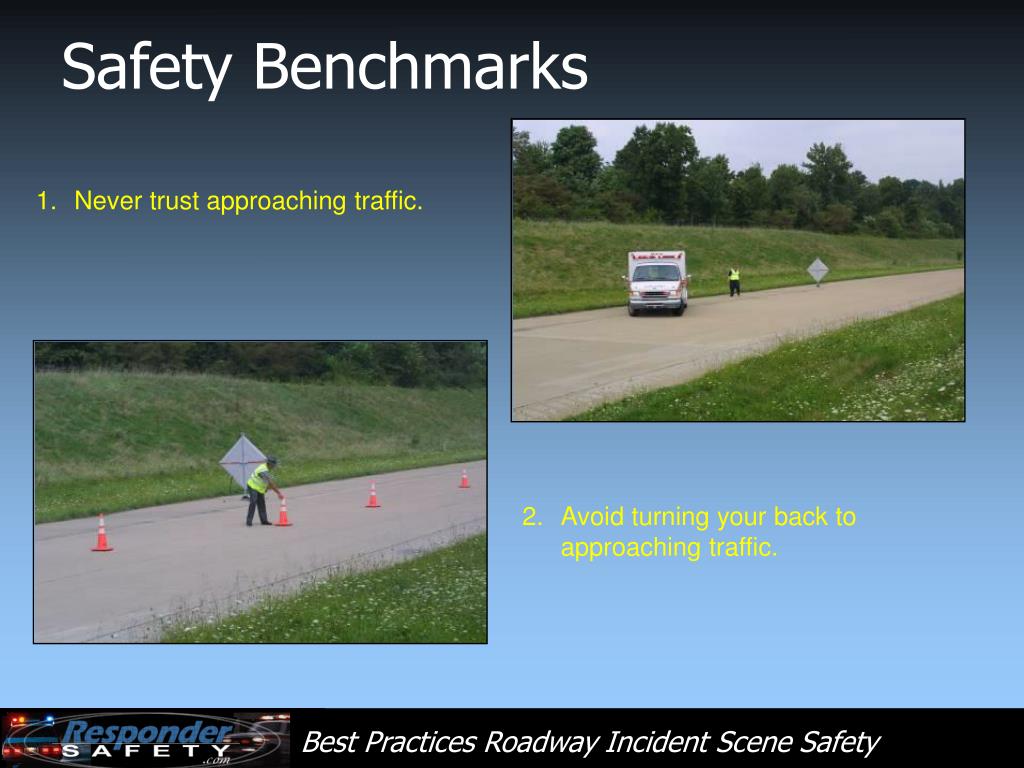
Safety Benchmarks. 1. Never trust approaching traffic. Avoid turning your back to approaching traffic. Safety Benchmarks . Establish an initial block with the first arriving emergency vehicle or fire apparatus. . Safety Benchmarks.
Safety Benchmarks - slide 1
01 / 9Safety Benchmarks
1 / 17

Télécharger la présentation

Safety Benchmarks
Une image / un lien ci-dessous est fourni (tel quel) pour télécharger la présentation

Politique de téléchargement : le contenu du site vous est fourni TEL QUEL pour votre information et votre usage personnel ; il ne peut être vendu, concédé sous licence ni partagé sur d’autres sites sans l’accord de son auteur.Le contenu vous est fourni TEL QUEL, pour votre information et votre usage personnel uniquement. Téléchargez la présentation en cliquant sur ce lien. Lors du téléchargement, si vous ne parvenez pas à télécharger une présentation, l’éditeur a peut-être supprimé le fichier de son serveur.Pendant le téléchargement, si vous ne parvenez pas à obtenir une présentation, le fichier a peut-être été supprimé par l’éditeur.

F I N

Plus de contenu associé

Transcription de la présentation
  1. Safety Benchmarks 1. Never trust approaching traffic. • Avoid turning your back to approaching traffic. Best Practices Roadway Incident Scene Safety

  2. Safety Benchmarks • Establish an initial block with the first arriving emergency vehicle or fire apparatus. Best Practices Roadway Incident Scene Safety

  3. Safety Benchmarks • Wear appropriate PPE including ANSI high visibility vests as required by department policy. Best Practices Roadway Incident Scene Safety

  4. Safety Benchmarks • At nighttime incidents turn off all sources of vision impairment to approaching vehicles including vehicle headlights and spotlights. Photo By: Sarah Britain Best Practices Roadway Incident Scene Safety

  5. Safety Benchmarks • Use fire apparatus and police vehicles to initially slow down redirect the flow of moving traffic. Best Practices Roadway Incident Scene Safety

  6. 200’ min Safety Benchmarks • Establish advance warning and adequate transition area traffic control measures upstream of incident to reduce travel speeds of approaching motorists. Best Practices Roadway Incident Scene Safety

  7. Safety Benchmarks • Establish advance warning and adequate transition area traffic control measures upstream of incident to reduce travel speeds of approaching motorists. Best Practices Roadway Incident Scene Safety

  8. Safety Benchmarks • Use traffic cones and/or cones illuminated by flares where safe to do so for sustained highway incident traffic control and direction. Best Practices Roadway Incident Scene Safety

  9. Safety Benchmarks • Assign personnel to monitor approaching traffic and activate an emergency signal if the actions of a motorist do not conform to established traffic control measures in place at the highway scene. Note: The Trooper in this photo is not in a protected location. A safer location would be on the shoulder of the road, beside a piece of apparatus, or at a minimum behind the cone line established to direct the flow of traffic. Another important consideration is for personnel in this position to have a traffic control device such as a flag, stop/slow paddle, or an illuminated flashlight. Best Practices Roadway Incident Scene Safety