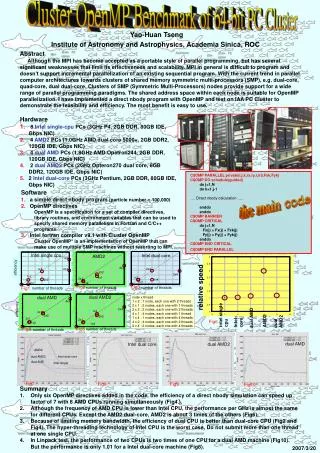
Advanced Computational Astrophysics: Hardware and Software for High-Performance Simulations
This research showcases the high-performance computing capabilities at the Institute of Astronomy and Astrophysics, Academia Sinica. Utilizing an 8-single CPU cluster and 10 dual-CPU cluster setup with powerful specs, the system achieves a Linpack Benchmark of 60.51 Gflops. The software stack includes renowned compilers and libraries like Intel, PGI, MPI, and MATLAB for astrophysical modeling. Applications range from simulating supermassive black hole formations to cosmological models, contributing significantly to the understanding of astrophysics phenomena.

Advanced Computational Astrophysics: Hardware and Software for High-Performance Simulations
E N D
Presentation Transcript
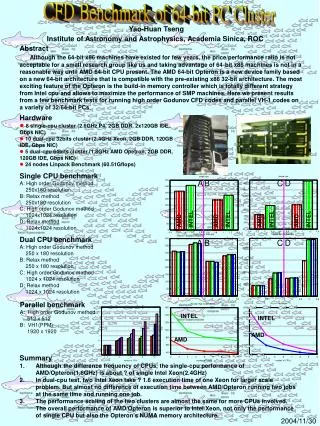
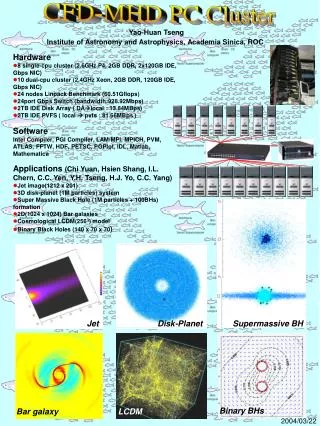
CFD-MHD PC Cluster Yao-Huan Tseng Institute of Astronomy and Astrophysics, Academia Sinica, ROC • Hardware • 8 single-cpu cluster (2.6GHz P4, 2GB DDR, 2x120GB IDE, Gbps NIC) • 10 dual-cpu cluster (2.4GHz Xeon, 2GB DDR, 120GB IDE, Gbps NIC) • 24 nodes Linpack Benchmark (60.51Gflops) • 24port Gbps Switch (bandwidth:928.92Mbps) • 2TB IDE Disk Array ( DAlocal : 13.84MBps) • 2TB IDE PVFS ( local pvfs : 81.66MBps ) • Software • Intel Compiler, PGI Compiler, LAM/MPI, MPICH, PVM, ATLAS, FFTW, HDF, PETSC, PGPlot, IDL, Matlab, Mathematica • Applications (Chi Yuan, Hsien Shang, I.L. Chern, C.C. Yen, Y.H. Tseng, H.J. Yo, C.C. Yang) • Jet image(1212 x 201) • 3D disk-planet (1M particles) system • Super Massive Black Hole (1M particles + 100BHs) formation • 2D(1024 x 1024) Bar galaxies • Cosmological LCDM(2563) model • Binary Black Holes (140 x 70 x 70) Jet Disk-Planet Supermassive BH Binary BHs Bar galaxy LCDM 2004/03/22