Insights into Selectivity-Determining Regions of PTP Active Sites and Their Role in Substrate Recognition
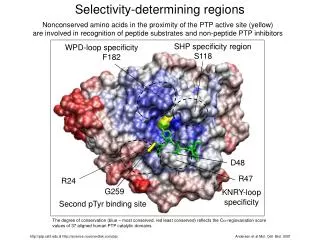
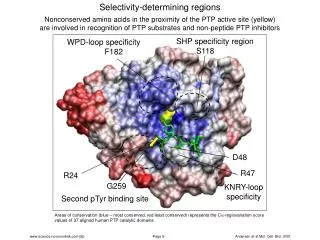
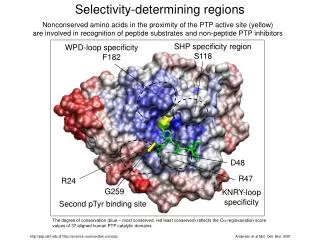
The study explores non-conserved amino acids near the PTP active site that play crucial roles in recognizing peptide substrates and non-peptide inhibitors. Key regions such as the SHP specificity region, WPD-loop, and the second pTyr binding site are analyzed. The conservation degree of these amino acids is indicated by a color scale, providing insight into evolutionary variation among 37 aligned human PTP catalytic domains. Understanding these dynamics can enhance our knowledge of PTP specificity and its impacts on cellular signaling.

Insights into Selectivity-Determining Regions of PTP Active Sites and Their Role in Substrate Recognition
E N D
Presentation Transcript
Selectivity-determining regions Nonconserved amino acids in the proximity of the PTP active site (yellow) are involved in recognition of peptide substrates and non-peptide PTP inhibitors SHP specificity region S118 WPD-loop specificity F182 D48 R47 R24 G259 KNRY-loop specificity Second pTyr binding site The degree of conservation (blue – most conserved, red least conserved) reflects the Ca-regiovariation score values of 37 aligned human PTP catalytic domains. http://ptp.cshl.edu & http://science.novonordisk.com/ptp Andersen et al Mol. Cell. Biol. 2001