Download
1 / 1
10 likes | 127 Vues
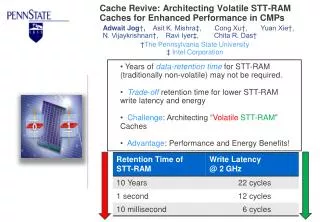
This research explores the potential of using volatile STT-RAM caches, challenging the traditional notion of non-volatile retention in STT-RAM. By analyzing trade-offs between retention time, write latency, and energy consumption, the study proposes innovative architectures to improve performance in chip multiprocessors (CMPs). The findings suggest that rethinking data retention requirements can lead to significant performance gains and energy efficiency in computing systems, paving the way for new cache designs optimized for modern workloads.

E N D
Adwait Jog†, Asit K. Mishra‡, Cong Xu†, Yuan Xie†, N. Vijaykrishnan†, Ravi Iyer‡, Chita R. Das† †The Pennsylvania State University ‡Intel Corporation • Years of data-retention time for STT-RAM (traditionally non-volatile) may not be required. • Trade-off retention time for lower STT-RAM write latency and energy • Challenge: Architecting “VolatileSTT-RAM” Caches • Advantage: Performance and Energy Benefits! Cache Revive: Architecting Volatile STT-RAM Caches for Enhanced Performance in CMPs