Risk Management
Risk Management. Contents. Define risk and risk management Describe the components of risk management List and describe vulnerability scanning tools Define penetration testing. Risk Management, Assessment, and Mitigation.

Risk Management
E N D
Presentation Transcript
Contents • Define risk and risk management • Describe the components of risk management • List and describe vulnerability scanning tools • Define penetration testing
Risk Management, Assessment, and Mitigation • One of the most important assets any organization possesses is its data • Unfortunately, the importance of data is generally underestimated • The first steps in data protection actually begin with understanding risks and risk management
What Is Risk? • In information security, a risk is the likelihood that a threat agent will exploit a vulnerability • More generally, a risk can be defined as an event or condition that could occur • And if it does occur, then it has a negative impact • Risk generally denotes a potential negative impact to an asset
Definition of Risk Management • Realistically, risk cannot ever be entirely eliminated • Would cost too much or take too long • Rather, some degree of risk must always be assumed • Risk management • A systematic and structured approach to managing the potential for loss that is related to a threat
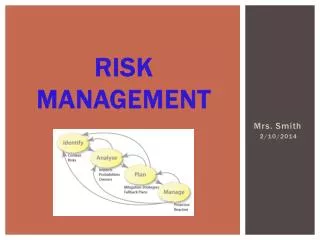
Steps in Risk Management • The first step or task in risk management is to determine the assets that need to be protected • Asset identification • The process of inventorying and managing these items • Types of assets: • Data • Hardware • Personnel • Physical assets • Software
Attributes of Assets • Along with the assets, the attributes of the assets need to be compiled • Attributes are details • Important to determine each item’s relative value
Determining Relative Value • Factors that should be considered in determining the relative value are: • How critical is this asset to the goals of the organization? • How difficult would it be to replace it? • How much does it cost to protect it? • How much revenue does it generate?
Determining Relative Value • Factors that should be considered in determining the relative value are: (continued) • How quickly can it be replaced? • What is the cost to replace it? • What is the impact to the organization if this asset is unavailable? • What is the security implication if this asset is unavailable?
Threat Identification • The next step is to determine the threats from threat agents • Threat agent • Any person or thing with the power to carry out a threat against an asset • Threat modeling • Constructs scenarios of the types of threats that assets can face • Helps to understand who the attackers are, why they attack, and what types of attacks might occur
Attack Tree • Provides a visual image of the attacks that may occur against an asset Goal Method Method Method Method Method
Vulnerability Appraisal • Finding security weaknesses that expose assets to threats • Takes a snapshot of the security of the organization as it now stands • Every asset must be viewed in light of each threat • Determining vulnerabilities often depends upon the background and experience of the assessor
Risk Assessment • Determining: • The damage that would result from an attack, and • The likelihood that the vulnerability is a risk to the organization
Anticipated Losses • Single Loss Expectancy (SLE) • The expected monetary loss every time a risk occurs • Annualized Loss Expectancy (ALE) • The expected monetary loss that can be expected for an asset due to a risk over a one-year period
Risk Mitigation • The final step--determine what to do about the risks • Options when confronted with a risk: • Diminish the risk • Transfer the risk • Outsourcing or insurance • Accept the risk
Identifying Vulnerabilities • Identifying vulnerabilities through a vulnerability appraisal • Determines the current security weaknesses that could expose assets to threats • Two categories of software and hardware tools • Vulnerability scanning • Penetration testing
Vulnerability Scanning • Vulnerability scanning is typically used by an organization to identify weaknesses in the system • That need to be addressed in order to increase the level of security • Tools include port scanners, network mappers, protocol analyzers, vulnerability scanners, the Open Vulnerability and Assessment Language, and password crackers
IP Addresses and Ports • Internet protocol (IP) addresses • The primary form of address identification on a TCP/IP network • Used to uniquely identify each network device • Port number • TCP/IP uses a numeric value as an identifier to applications and services on the systems • Each datagram (packet) contains not only the source and destination IP addresses • But also the source port and destination port
Port Scanners • Port scanner • Sends probes to interesting ports on a target system • Determines the state of a port to know what applications are running and could be exploited • Three port states: • Open, closed, and blocked
Network Mappers • Software tools that can identify all the systems connected to a network • Most network mappers utilize the TCP/IP protocol ICMP • Internet Control Message Protocol (ICMP) • Used by PING to identify devices • Less useful for modern versions of Windows
Protocol Analyzers • Also called a sniffer • Captures each packet to decode and analyze its contents • Can fully decode application-layer network protocols • Common uses include: • Network troubleshooting • Network traffic characterization • Security analysis
Vulnerability Scanners • Products that look for vulnerabilities in networks or systems • Help network administrators find security problems • Most vulnerability scanners maintain a database that categorizes and describes the vulnerabilities that it can detect • Other types of vulnerability scanners combine the features of a port scanner and network mapper
Open Vulnerability and Assessment Language • OVAL • Designed to promote open and publicly available security content • Standardizes the transfer of information across different security tools and services • A “common language” for the exchange of information regarding security vulnerabilities • These vulnerabilities are identified using industry-standard tools
Open Vulnerability and Assessment Language • OVAL vulnerability definitions are recorded in Extensible Markup Language (XML) • Queries are accessed using the database Structured Query Language (SQL) • OVAL supports Windows, Linux, and UNIX platforms
Password Crackers • Password • A secret combination of letters and numbers that only the user knows • Because passwords are common yet provide weak security, they are a frequent focus of attacks • Password cracker programs • Use the file of hashed passwords and then attempts to break the hashed passwords offline • The most common offline password cracker programs are based on dictionary attacks or rainbow tables
Shadow File • A defense against password cracker programs for UNIX and Linux systems • On a system without a shadow fiile • The passwd file that contains the hashed passwords and other user information is visible to all users • The shadow file can only be accessed at the highest level and contains only the hashed passwords
Penetration Testing • Method of evaluating the security of a computer system or network • By simulating a malicious attack instead of just scanning for vulnerabilities • Involves a more active analysis of a system for vulnerabilities • One of the first tools that was widely used for penetration testing as well as by attackers was SATAN
SATAN • SATAN could improve the security of a network by performing penetration testing • To determine the strength of the security for the network and what vulnerabilities may still have existed • SATAN would: • Recognize several common networking-related security problems • Report the problems without actually exploiting them • Offer a tutorial that explained the problem, what its impact could be, and how to resolve the problem