Satellite Motion
Satellite Motion. Monika V Sikand Ph.d Student Stevens Institute of Technology Department of Physics. Light and Life Laboratory. Hoboken. OBJECTIVE. Review laws of motion and gravitation Satellite motion Escape velocity Geosynchronous orbit(Telecommunication satellites).

Satellite Motion
E N D
Presentation Transcript
Satellite Motion Monika V Sikand Ph.d Student Stevens Institute of Technology Department of Physics. Light and Life Laboratory. Hoboken.
OBJECTIVE • Review laws of motion and gravitation • Satellite motion • Escape velocity • Geosynchronous orbit(Telecommunication satellites)
Newton’s laws of motion I. Law of Inertia II. F=ma III. Action-Reaction Isaac Newton January 4, 1643 -March31,1727
Gravity is a pulling force It pulls things down towards the earth
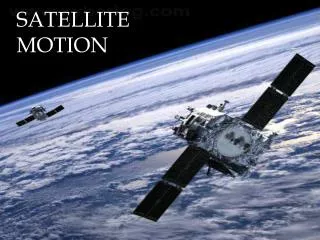
Satellite Smaller body revolving around a larger body
Natural satellites Moon, planets, comet
Artificial satellites Weather , spy , communication
Escape velocity Artificial satellite in a circular orbit around earth first achieving a speed of 7900m/s. If speed greater than 7900m/s satellite has a elliptical orbit. If velocity greater than 11km/s then satellite leaves earth’s orbit and has a escape orbit. The escape orbit’s velocity is called escape velocity.
Geostationary Earth Orbit (GEO) • Orbit is synchronous with the earths rotation. • From the ground the satellite appears fixed. • Altitude is about 22,300 miles or 36,000Km. • Coverage to 40% of planet per satellite.
Conclusion • Newton’s law of gravitation F =Gm1m2/r2 • Satellites are revolving bodies around earth. • Escape velocity is the maximum velocity required to escape the earth’s orbit. • Geostationary orbits are synchronized with earth’s rotation at 36000 km of height.