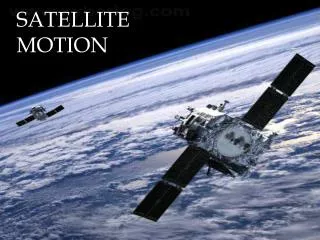
Introduction to Satellite Motion
Introduction to Satellite Motion. Satellite Motion. Contents: Introduction Kepler’s Laws Kepler Elements. Introduction. Where is the spacecraft? Where is it going? How and why?. Ikonos Imaging Satellite. Satellite Motion. From the beginning…. History Lesson.

Introduction to Satellite Motion
E N D
Presentation Transcript
Satellite Motion • Contents: • Introduction • Kepler’s Laws • Kepler Elements
Introduction • Where is the spacecraft? • Where is it going? • How and why?
Satellite Motion • From the beginning…
History Lesson • 270 BC Aristarchus of Samos proposes a sun centred universe. • 140 AD Ptolemy proposes earth centred universe
Copernicus (1473 - 1543) • Explains planetary motion in a sun centred universe • Proposes circular orbits with epicircles
Tycho Brahe (1546 - 1601) • Measured motion of planets to an unprecedented accuracy. • Proposed a model where the planets orbit the sun and the sun orbits the earth.
Johannes Kepler (1571-1630) • From Brahe’s measurements of mars’ motion concluded that mars’ orbit was elliptical with the sun at one focus.
Kepler’s First Law • The planets move in a plane; the orbits described are ellipses with the sun at one focus (1602).
Kepler’s Second Law • The vector from the sun to the planet sweeps equal areas in equal times (the law of areas, 1605).
Kepler’s Third Law • The ratio of the square of the period of revolution of a planet around the sun to the cube of the semi major axis of the ellipse is the same for all planets (1618).
Kepler Elements • Objective: • Define the satellite’s position • Solution: • Define the size and shape of the orbit • Define the orbit in space • Define the satellite’s position in the orbit • Kepler Elements
Orbit Size and Shape • Size: semi major axis, a • Shape: eccentricity, e
Defining the Orbital Plane in Space • Inclination, i • Right Ascension of the ascending node, • Argument of Perigee,
STK Simulation • IPN_Molniya
Inclination, i • Angle between the equatorial plane and the orbital plane
Right Ascension of the Ascending Node, • Angle between the vernal equinox direction and the ascending node.
Argument of Perigee, • Angle between the ascending node and perigee
Defining Satellite’s Position in the Orbit • True anomaly,
Kepler’s Laws • The planets move in a plane; the orbits described are ellipses with the sun at one focus (1602). • The vector from the sun to the planet sweeps equal areas in equal times (the law of areas, 1605). • The ratio of the square of the period of revolution of a planet around the sun to the cube of the semi major axis of the ellipse is the same for all planets (1618).