Understanding Motion: Position, Velocity, and Acceleration in Physics
This guide explores the fundamentals of motion, emphasizing position-time, velocity-time, and acceleration-time graphs. Key concepts include distance, displacement, speed, average and instantaneous velocity, and acceleration. Learn how to analyze motion through graphs, calculate average speed and velocity, and understand vital physics terms. The guide includes practical examples and critical points to help physics students grasp these concepts. Engage in discussions and collaborative exercises to reinforce your understanding of motion in a structured manner.

Understanding Motion: Position, Velocity, and Acceleration in Physics
E N D
Presentation Transcript
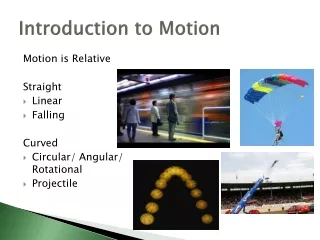
Introduction to Motion Position-Time Graphs Velocity-Time Graphs Acceleration-Time Graphs
x t WALK THIS WAY:
x t WALK THIS WAY:
x t WALK THIS WAY:
x t WALK THIS WAY:
x t WALK THIS WAY: Y-intercept? Slope?
v t WALK THIS WAY (NOTE - VELOCITY GRAPH):
v t WALK THIS WAY (NOTE - VELOCITY GRAPH):
v t WALK THIS WAY (NOTE - VELOCITY GRAPH): Y-intercept? Slope? Area under curve?
a t WALK THIS WAY (NOTE – ACCELERATION GRAPH):
a t WALK THIS WAY (NOTE – ACCELERATION GRAPH): Y-intercept? Area under curve? Slope?
Let’s define some important terms: • Distance • Displacement • Speed • Average velocity • Instantaneous velocity • Average Acceleration • Instantaneous Acceleration
r = 1 m Distance: path length in meters; a scalar Displacement: final position minus initial position, in meters. Displacement is a VECTOR! distance = 2p m Dx= 0 m
One revolution in 3.14 s. r = 1 m Speed: distance divided by total time, in m/s Average velocity: displacement divided by total time, in m/s. Velocity is a VECTOR! speed = 2 m/s vav = 0 m/s
A horse canters away from its trainer in a straight line, • moving 150 m away in 14 s. It then turns abruptly and • gallops halfway back in 4.5 s. Calculate • its average speed for the entire trip and • its average velocity for the entire trip. • Use “away from the trainer” as the positive direction.
x (m) t (s) • Instantaneous velocity: velocity at one point in time, in m/s. • It is a VECTOR!
Average Acceleration: rate of change of velocity, in m/s2. • It is a VECTOR! • Instantaneous Acceleration: acceleration at one point in time, in m/s2. • Also a VECTOR!
Graph things every physics student should know: Initial position, x0 Average velocity Nothing Initial velocity, v0 Average acceleration Displacement Initial acceleration, a0 Change in Velocity Jerk
v (m/s) 25 20 15 10 5 t (s) 0 10 15 20 5 Draw the corresponding acceleration-time graph: Draw the corresponding position-time graph.
Summarize! Review your notes for three minutes and mark the key ideas from the discussion. Then, trade with a partner to see if you have marked the same things.
Y-intercept Slope Area under curve x vs. t v vs. t a vs. t Graph things every physics student should know:
Common word problem phrases Starts from rest…v0=0 ...after __ sec… Dt=___ Comes to rest, vf=0 Initial…at time =0 Moves a total of _ meters…Dx=__ …max height…v @ hmax=0, and Dh=