Two-Column Proof for Angle Relationships
This document presents a detailed two-column proof based on Example 4 from Lesson 2.5. It establishes that the sum of angles 1 and 2 equals angle DBC, with given relationships and conclusions derived using geometric postulates and properties. The proof utilizes the Angle Addition Postulate, the Transitive Property of Equality, and the Substitution Property of Equality to validate the relationships between the angles. This format distinguishes between statements and reasons clearly, facilitating understanding and verification of the proof process.

Two-Column Proof for Angle Relationships
E N D
Presentation Transcript
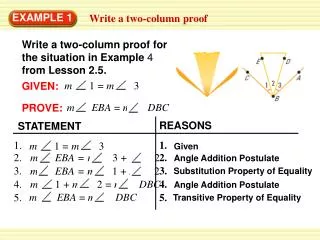
Write a two-column proof for the situation in Example 4 from Lesson 2.5. 4. m∠ 1+m∠ 2=m∠ DBC m∠ 1=m∠ 3 GIVEN: m∠ EBA=m∠ DBC PROVE: 4. Angle Addition Postulate REASONS m∠ EBA= m∠ DBC STATEMENT 5. 5. Transitive Property of Equality 1. 1. m∠ 1=m∠ 3 Given 2. Angle Addition Postulate 2. m∠ EBA=m∠ 3+m∠ 2 3. Substitution Property of Equality 3. m∠ EBA=m∠ 1+m∠ 2 EXAMPLE 1 Write a two-column proof
1. Four steps of a proof are shown. Give the reasons for the last two steps. for Example 1 GUIDED PRACTICE GIVEN :AC = AB + AB PROVE :AB = BC
ANSWER GIVEN :AC = AB + AB PROVE :AB = BC REASONS STATEMENT 1. 1. AC = AB + AB Given 2. 2. AB + BC = AC Segment Addition Postulate 3. 3. AB + AB = AB + BC Transitive Property of Equality 4. 4. AB = BC Subtraction Property of Equality for Example 1 GUIDED PRACTICE