Download
1 / 30
340 likes | 478 Vues
The Cell Theory, originating from the discoveries of Robert Hooke in 1665 and Anton van Leeuwenhoek in 1673, established that all living organisms are composed of one or more cells, which are the fundamental units of life. Matthias Schleiden and Theodor Schwann later expanded on this, affirming that all plant and animal tissues consist of cells. The Modern Cell Theory adds that cells contain hereditary information (DNA), share similar chemical compositions, and that all physiological functions occur within cells. Understanding prokaryotic and eukaryotic cells, along with organelle functions, is crucial for comprehending life processes.

E N D
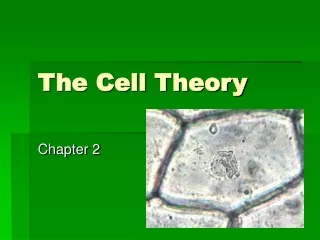
1. Discovery of the Cell • 1665- English Scientist, Robert Hooke, discovered cells while looking at a thin slice of cork. • Anton van Leuwenhoek - 1673- Used a handmade microscope to observe pond scum & discovered single celled organisms. He called them “animalcules.”
2. The Cell Theory 1838- German Botanist, Matthias Schleiden, concluded that all plant parts are made of cells 1839- German physiologist, Theodor Schwann, who was a close friend of Schleiden, stated that all animal tissues are composed of cells.
3. The Cell Theory All organisms are composed of one or more cells. The cell is the basic unit of life in all living things. All cells are produced by the division of preexisting cells.
d. The Modern Cell Theory a. Modern Cell Theory contains 4 statements, in addition to the original Cell Theory: • The cell contains hereditary information (DNA) which is passed on from cell to cell during cell division. • All cells are basically the same in chemical composition and metabolic activities. • All basic chemical & physiological functions are carried out inside the cells (movement, digestion, etc.) • Cell activity depends on the activities of sub-cellular structures within the cell(organelles, nucleus, plasma membrane)
1. Prokaryotic Cells cells that have genetic material not contained within a nucleus. All bacteriaare prokaryotes.
a. Organelles – 2 parts • Nucleus – control center of the cell • nucleolus - produces ribosomes • chromosomes - contains genetic material • Nuclear membrane/ envelope - regulates what enters and exits the nucleus.
a. Organelles – 2 parts • Ribosomes - assembles proteins • Endoplasmic Reticulum (rough or smooth) • lipid components of the cell membrane are assembled • exports materials from the cell
a. Organelles – 2 parts 3.Golgi Body/ complex - packages proteins for storage or export
a. Organelles – 2 parts 4. Lysosomes - enzyme filled organelles that break down excess material in the cell.
a. Organelles – 2 parts 5.Vacuole - storage
a. Organelles – 2 parts 6. Mitochondria - produces energy from glucose
a. Organelles – 2 parts 7.Chloroplasts - site of photosynthesis in plant cells
a. Organelles – 2 parts 8. Microtubules (filaments) - network of filaments that help the cell maintain its shape.
a. Organelles – 2 parts 9.Cell wall - rigid outer boundary of plant cells. Helps the cell maintain its shape.
a. Organelles – 2 parts 10.Centrioles - aide in cell division