Download
1 / 6
60 likes | 178 Vues
This overview explores the basics of cellular structure and function, focusing on cell theory. It highlights that all organisms are made of one or more cells, which serve as the basic unit of structure and organization. The section discusses different types of microscopes, such as light and electron microscopes, and their magnification capabilities. Moreover, it differentiates between prokaryotic and eukaryotic cells, emphasizing structural complexity and organelles, while detailing the role of the plasma membrane in nutrient absorption and waste removal.

E N D
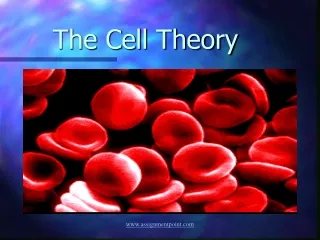
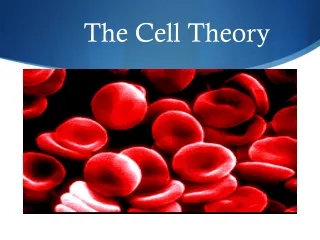
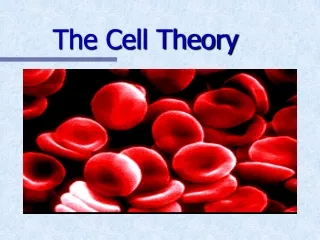
Cellular Structure and Function Section 1 Cell Discovery and Theory The Cell Theory • All organisms are composed of one or more cells. • The cell is the basic unit of structure and organization of organisms. • All cells come from preexisting cells.
Cellular Structure and Function Section 1 Cell Discovery and Theory Light Microscopes • Utilizes a series of glass lenses and visible light to magnify an image • Magnifies images up to 1,000 times the actual size CMCD/Getty Images
Utilizes magnets to aim a beam of electrons at Cellular Structure and Function a cell to produce an image Section 1 Cell Discovery and Theory Electron Microscopes • Magnifies images up to 500,000 times the actual size MedicalRF.com/Getty Images
Cellular Structure and Function Section 1 Cell Discovery and Theory Prokaryotic Cell • Simple structure • Contains a plasma membrane • Does not contain membrane-bound organelles Steven P. Lynch
Cellular Structure and Function Section 1 Cell Discovery and Theory Eukaryotic Cell • More complex structure • Contains a plasma membrane • Contains membrane-bound organelles The McGraw-Hill Companies, Inc./Al Telser, photographer
Cellular Structure and Function Section 1 The Plasma Membrane Plasma Membrane • Thin, flexible boundary between the cell and its environment • Allows nutrients into the cell • Allows waste to leave the cell