Download
1 / 12
120 likes | 266 Vues
This document provides an overview of Attention Deficit Hyperactivity Disorder (ADHD) as outlined in the DSM-IV-TR. It discusses the three types of ADHD—combined, predominantly inattentive, and predominantly hyperactive-impulsive—along with prevalence rates among school-aged children, genetic factors, and brain functioning. Key comorbidities are highlighted, and the diagnostic evaluation process is detailed, including necessary assessments and challenges in diagnosis. It also reviews effective interventions such as educational accommodations, behavior management, and medication options.

E N D
Attention Deficit Disorder December 8, 2004
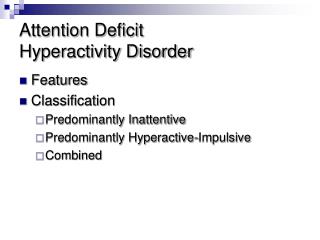
Attention Deficit Hyperactivity Disorder: DSM-IV-TR • ADHD: combined type • ADHD: predominantly inattentive type • ADHD: predominantly hyperactive-impulsive type
Prevalence Data • Approximately 3-7% of school-aged children have ADHD. • Estimates that 23-50% of children receiving clinical services have ADHD. • Occurs more frequently in males than females • 3:1 non-clinic samples • 6:1 clinic samples
Etiology • Genetic Component • Twin studies: 51% concordance for monozygotic twins; 33% in dizygotic twins. • Brain Functioning • Decreased activity of inhibitory areas of the brain (e.g., prefrontal cortex). • Impairments on executive function tasks.
ADHD Comorbidity • Learning Disorders: 25-50% • Oppositional Defiant Disorder: 35% • Conduct Disorder: 26% • Depressive Disorder: 18% • Anxiety Disorder: 26%
ADHD Diagnostic Evaluation • Parent Interview • Parent & Teacher Ratings (broad and narrow) • Intellectual Assessment • Achievement Testing
Issues in Diagnosing ADHD • Age of onset – must be prior to 7 years • Developmental level – must be inconsistent with child’s mental age • Symptoms must be present in two or more settings • Medical confounds – must not be due to side effects associated with medical conditions or medications • Family/environmental confounds – rule out family stress, anxiety, depression as cause of symptoms
Performance-Based Assessment of ADHD (Rapport et al., 2000) • Continuous Performance Test • X only – discriminated between ADHD and non-ADHD on 18/21 studies (86%) • AX – 28/31 studies (93%) • Stop Signal (7/9 studies, 78%) • WISC-R Arithmetic (3/4 studies, 75%) • WISC-R Coding (3/4 studies, 75%) • Argue that all of these tasks involve working memory.
Behavioral Assessment Scale for Children (BASC) • 3 informant versions provide comparisons across multiple informants: • Parent • Teacher • Self-report • 3 age versions: • preschool (4 to 5 years) • child (6 to 11 years) • Adolescents (12 to 18 years)
University Medical CenterADHD Clinic Assessment Battery: • Parent interview • School questionnaire • Parent and teacher rating scales: • BASC • CSI-4 • IQ screener: WASI • Achievement screener: WRAT-3 • Physical Examination Case Study
Interventions • Educational Accommodations • Behavior Management • Positive reinforcement • Token economy • Medication Management • 60-90% respond to medication • See medication handout