
Understanding Probability: Models, Tree Diagrams, and Odds
E N D
Presentation Transcript
Probability Math 374
Game Plan • General • Models • Tree Diagram • Matrix Two Dimensional Model • Balanced • Unbalanced • Odds – for – odds against
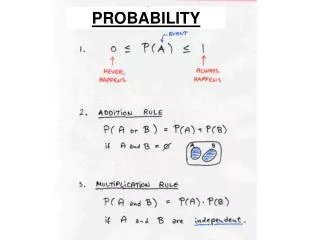
What is Probability • It is a number we assign to show the likelihood of an event occurring • We set the following limits • What is the probability that if I drop the piece of chalk it will fall to the floor? • P (fall) = 1 a certainly
Probability • What is the probability that the chalk will float up to the ceiling? • P (float) = 0 an impossibility
Probability Scale • We have created a scale 0 Absolute Impossibility 1 Absolute Certainty
Various Types of Probability • Subjective – gets you in trouble • Probability – (Canadiens will will Stanley Cup) • Experimental – you need to do an experiment • Probability (cars on an assembly line have a bad headlight). You would probably test 20 cars. If 1 was faulty you would say 1/20 are bad 0 1 0.8 (A fan) 0.1 A leafs fan
Various Types of Probability • Theoretical – the one we will use • Fundamental Definition • P = S R where s # of successes R # of possibilities
Examples • Consider flip a coin, what is the probability of getting a tail • S = (T) = 1 • R = (H, T) = 2 • P = ½
Examples • Roll a die, get a 5 • S = (5) = 1 • R = (1,2,3,4,5,6) = 6 • P = 1/6 • Roll a die, get more than 2 • S = (3,4,5,6) • R = 6 • P = 4/6 (you do not need to reduce in this chapter!)
Models • The key to understanding probability is to have a model that shows you the possibilities • This can get daunting, there are 311 875 200 possible poker hands from a standard deck. • The easiest model we will use is a tree • Tree Model - Flipping two coins H H T Starting Point H T T
We need to Determine R • In a balanced model just count the number of end branches i.e. 4 to determine denominator • OR 2) R = # of possibilities of first. # of possibilities of second. # of possibilities of third. 2 x 2 = 4 • Using the model P (getting two tails) • S How many branches from start to the end satisfy? • Let’s look at the various types of models
Tree Model H H Starting Point T H T T S = ? S = 1 Notice # of branches will be the denominator P = ? P = ¼ Look at the # of successes for numerator
Matrix Two Dimensional Model Die #1 • Rolling Two Die or Dice • Not a tree • Called a matrix – two dimensional • Eg P (getting a total 5) • S = 4 • P = 4/36 • Roll over 3 • Do not include 3 • P = 33/36 Die #2
Balanced Model • Consider a bag with 2 blue marbles and 3 red marbles. You are going to pick two and replace them. • Replace = put them back • What is the prob of getting a blue & red?
Balanced Model B P (blue & Red)? B # of successes? B R R Starting Point B 12 B Put check marks! R B R # of Possibilities? R R B B R R R R R B B R R = 25 R R R B B P = 12/25 R R R
Unbalanced Model • It is not always possible to write out every single branch. Consider the same question; • What is the P of getting a blue and a red? • This time we create an unbalanced model To find den. ADD branches and MULT each one. (It differs if you have 3 options). 2 S? B 3 (2x3)+(3x2) 2 B R 2 Starting Point 3 B R? R R=5x5 3 R P=12/25
Unbalanced Model • Create a model given a bag with 20 blue, 15 green and 15 red marbles. You are picking three marbles and replacing them. • What is the probability of getting three green? • Draw the model! • S = ? • 15 x 15 x 15 • R = ? • 50 x 50 x 50 • P = 3375 / 125000
Unbalanced Model • What is the probability of getting a blue, a green and a red? • Since they do not mention it, we must assume order does not matter. • We need to look at BGR, BRG, GRB, GBR, RBG and RGB. • S = (20x15x15) + ? + (20x15x15) + (15x15x20) + (15x20x15) + (15x20x15) + (15x15x20) = 27000 • P = 27000 / 125000
Without Replacement • Without replacement = not putting them back (you have less possibilities afterwards) • Given a bag with 5 red, 10 blue and 15 green and you will pick three marbles and do not replace them. • Create a model
Without Replacement • What is the probability of getting a B-R-G in any order? (5 red, 10 blue and 15 green) • So we are looking at RBG, RGB, BRG BGR GRB GBR • S = (5x10x15) + (5x15x10) + (10x5x15) + (10x15x5) + (15x5x10) + (15x10x5) = 4500 • R = ? • P = 4500 / 24360 R = 30 x 29 x 28 = 24360
Without Replacement • What is the probability of getting 2 B and one G or two G and one B? • So we are looking at BBG BGB GBB GGB GBG BGG • S = (10x9x15) + (10x15x9) + (15x10x9) + (15x14x10) + (15x10x14) + (10x15x14) = 10350 • P = 10350 / 24360 • Do Stencil #5,6,7
Odds For – Odds Against • Another way of showing a situation in probability is by odds • Note: These are not bookie odds – that is subjective probability! • We have so far P = S R • We will now define F as the number of failures. Thus S + F = R • # of Successes + # of Failures = # of Possibilities
Odds For • Odds for are stated S : F • Eg The odds for flipping a coin and getting a head is 1:1 • Eg The odds for flipping two coins and getting two heads 1:3
Odds Against • Odds against are stated F : S • Eg The odds against flipping two coins and getting two heads • 3:1 • If the odds for an event are 8:3, what is the probability? • S = 8, F = 3 Thus R = 8 + 3 = 11 • P = 8 / 11
Last Question • If the odds against are 9:23, what are the odds for and probability • 23:9 • P = 23/32 • Do Stencil #8, & #9