Essential Concepts in Scientific Inquiry: Definitions and Understanding
100 likes | 230 Vues
This document consolidates key terms and definitions within scientific inquiry, emphasizing the foundational aspects of science. It covers concepts such as inference, validity, quantitative vs qualitative data, the scientific method, and variables in experiments. The goal of science is outlined as investigating and understanding the natural world to make useful predictions. This resource serves as a guide for students to grasp fundamental scientific principles and terminologies vital for their academic journey in science.


Essential Concepts in Scientific Inquiry: Definitions and Understanding
E N D
Presentation Transcript
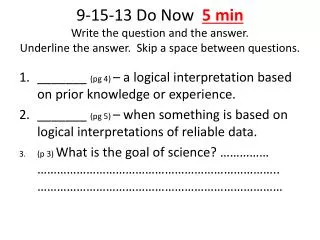
9-15-13 Do Now 5 min Write the question and the answer. Underline the answer. Skip a space between questions. • _______ (pg 4) – a logical interpretation based on prior knowledge or experience. • _______ (pg 5) – when something is based on logical interpretations of reliable data. • (p 3) What is the goal of science? …………… ……………………………………………………………….. …………………………………………………………………
9-15-13 Do Now 5 min Write the question and the answer. Underline the answer. Skip a space between questions. • inference(pg 4) – a logical interpretation based on prior knowledge or experience. • valid(pg 5) – when something is based on logical interpretations of reliable data. • (p 3) What is the goal of science? To investigate and understand the natural world, to explain events in the natural world, and to use those explanations to make useful predictions.
9-16-13 Do Now 5 min Write the question and the answer. Underline the answer. Skip a space between questions. • (pg 4) Explain the difference between quantitative and qualitative data. • (from your notes and page 5) What steps does a scientist take before he develops a hypothesis? What is a hypothesis?
9-16-13 Do Now 5 min Write the question and the answer. Underline the answer. Skip a space between questions. • (pg 4) Explain the difference between quantitative and qualitative data. Quantitative data are expressed in numbers obtained by counting or measuring. Qualitative data are descriptive. • What steps does a scientist take before he develops a hypothesis ? What is a hypothesis? A scientist observes and does background research before proposing a hypothesis. Therefore a hypothesis is a proposed scientific explanation for those observations.
9-17-13 Do Now 5 min Write the question and the answer. Underline the answer. Skip a space between questions. • __________ (pg 8) - the believe that life could arise from non-living matter. • __________ (pg 9) – a type of experiment in which only one variable is changed at a time. • _________ (pg 9) are the factors in an experiment that can change.
9-17-13 Do Now 5 min Write the question and the answer. Underline the answer. Skip a space between questions. • Spontaneous generation (pg 8) - the believe that life could arise from non-living matter. • Controlled experiment(pg 9) – a type of experiment in which only one variable is changed at a time. • Variables (pg 9) are the factors in an experiment that can change.
9-18-13 Do Now 5 min Write the question and the answer. Underline the answer. Skip a space between questions. • ______ - the variable that is changed deliberately. • _____- the variable that changes in response to the independent variable. • _____ - when evidence from numerous investigations supports a hypothesis.
9-18-13 Do Now 5 min Write the question and the answer. Underline the answer. Skip a space between questions. • Independent variable - the variable that is changed deliberately. • Dependent variable - the variable that changes in response to the independent variable. • Theory - when evidence from numerous investigations supports a hypothesis.
9-19-13 Do Now 5 min Write the question and the answer. Underline the answer. Skip a space between questions. • ______ - thorough, more than necessary • ______- generally current, most frequent or common. • ______ - of or pertaining to life • ______ Greek philosopher that made extensive observations of the natural world.
9-19-13 Do Now 5 min Write the question and the answer. Underline the answer. Skip a space between questions. • Extensive - thorough, more than necessary • Prevailing - generally current, most frequent or common. • Viable - of or pertaining to life • Aristotle -Greek philosopher that made extensive observations of the natural world.