SlideServe
Menu
Préférences
© SlideServe · v2026

Understanding Data Types in Computing

elewa avatar
7 diapositives · 227 Views · Aug 04, 2014

Learn about different data types stored in computing, from boolean and alphanumeric data to real numbers, integers, dates, and other types like currency and image data. Explore how each type is used in storing and processing information.
Understanding Data Types in Computing - slide 1
01 / 7Understanding Data Types in Computing
1 / 17

Télécharger la présentation

Understanding Data Types in Computing
Une image / un lien ci-dessous est fourni (tel quel) pour télécharger la présentation

Politique de téléchargement : le contenu du site vous est fourni TEL QUEL pour votre information et votre usage personnel ; il ne peut être vendu, concédé sous licence ni partagé sur d’autres sites sans l’accord de son auteur.Le contenu vous est fourni TEL QUEL, pour votre information et votre usage personnel uniquement. Téléchargez la présentation en cliquant sur ce lien. Lors du téléchargement, si vous ne parvenez pas à télécharger une présentation, l’éditeur a peut-être supprimé le fichier de son serveur.Pendant le téléchargement, si vous ne parvenez pas à obtenir une présentation, le fichier a peut-être été supprimé par l’éditeur.

F I N

Plus de contenu associé

Transcription de la présentation
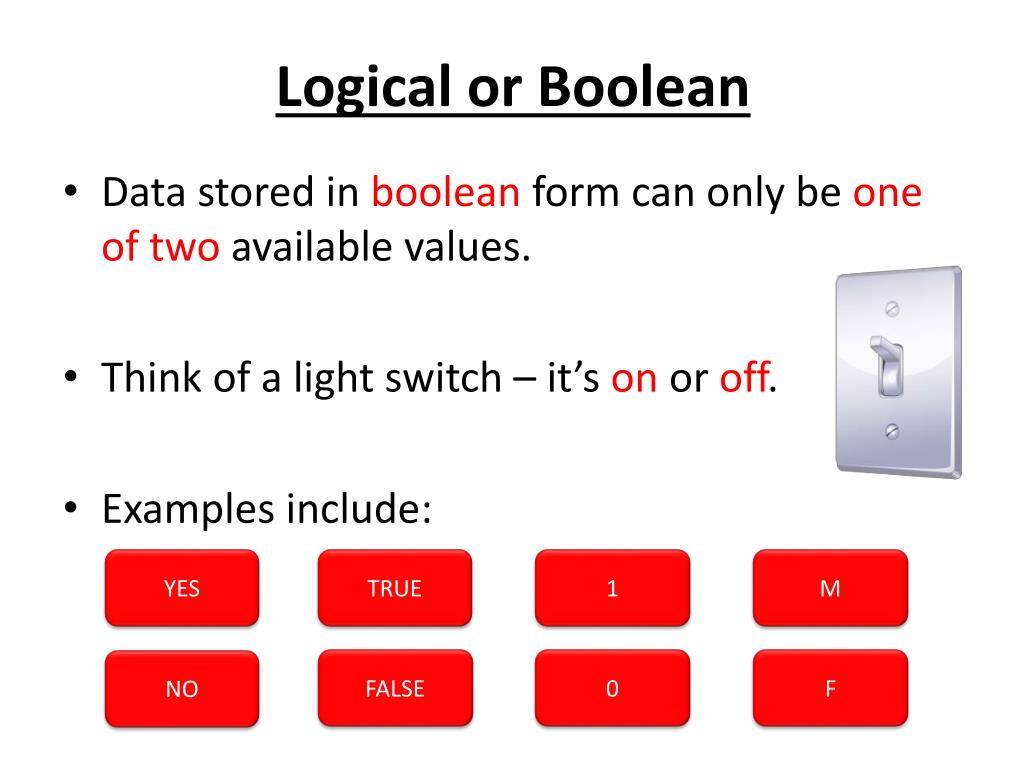
  1. Logical or Boolean • Data stored in boolean form can only be oneof two available values. • Think of a light switch – it’s on or off. • Examples include: YES TRUE 1 M FALSE 0 F NO

  2. Alphanumeric • Alphanumeric data is any combination of letters, numbersand symbols (@#¬|\/>< etc.) • This data type is also known as a string or text. • Examples: I like fish £4987 is a lot to pay for a badger DL61 ABC @*!#

  3. Alphanumeric Continued… • Alphanumeric or text/string is used to hold telephone numbers. • In a computer, telephone numbers are stored as text. • This is because the telephone number contains a leading zero and spaces.

  4. Real • A real number is one which has decimalplaces. • Examples: 3.14175 18.01 12.4

  5. Integer • Integer numbers are whole numbers, no bits, no decimal places. • Examples: 5 -54 999999

  6. Date • Dates can be stored in many different forms. • In the UK we write the date in the form DD/MM/YYYY e.g. 31/12/2014. • In the US, they use the form MM/DD/YYYYe.g. 12/31/2014. • Examples: 15/08/1999 2009/11/30 12/31/1999

  7. Other Data Types • Currency – Software will automatically add £ or $ to data and include decimal places. E.g. £22.99. • Image – Some databases will allow an image to be stored, for example a photo of a criminal and their fingerprints on a crime database.