Empowering Students Through the Student to Employment Program (STEP) for Workforce Success
The Student to Employment Program (STEP) assists students with disabilities in transitioning to the workforce. Collaborating closely with the IEP team and DORS counselors, the program identifies eligible participants and provides comprehensive job support services. STEP focuses on students who demonstrate a willingness to prioritize employment over post-secondary education, ensuring access to job placements, coaching, and resources. With a funding source lasting up to three years, STEP promotes successful integration into various fields of employment tailored to individual needs and capabilities.

Empowering Students Through the Student to Employment Program (STEP) for Workforce Success
E N D
Presentation Transcript
TO (STEP) Partners Process Timeline Access Eligibility Outcomes Resources
Partners in STEP • Transition Coordinator • Division of Rehabilitation (DORS) • Adult Service Providers - Humanim/Arc/Athelas • Parent/Student STEP
Identify possible participants Collaborative effort between IEP team and DORS counselor Application fulfillment- DORS and DDA (STEP)Process
Timeline • Referral to DORS year prior to exit • Upon meeting DORS eligibility criteria transition to adult agency prior to graduation • Tour adult agencies - Humanim, Athelas, Arc • Submit STEP application • 3 year funding source • Independent/DDA/MHA services
Access • Students exiting the school system who fit these criteria: • DORS eligible clients identified as most significantly in need of services, and • Who demonstrate that they require and can benefit from job support services in community job placements. • Students who are willing to prioritize their employment over pursuing post-secondary education are given priority for STEP funding
Eligibility • Cognitive Disabilities - Autism spectrum disorder, mental retardation, and learning disability • Psychosocial Disabilities -Bi-polar disorder and personality disorders • Physical Disabilities -Seizure disorder and spina bifida
Step PROFILES… • Students- Anxiety, Depression, Physical limitations • Limiting Job Skills and Interfering Work Habits- Multi-tasking, multi-step directions, socialization, speed, retention of tasks, adaptability, Off-task behavior, attention deficit, following directions, endurance • Job Coaching Support Needs- Job searches, applications, interview preparation, transportation, clothing attire opinions, grooming recommendations
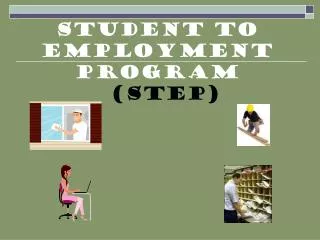
OutcomeS • Places of Employment- Library, Office, Warehouse, Restaurant, Mailroom, Retail, Construction • Length of Placement- Days-Weeks-Months • FY 2004= 7 • FY 2005 = 7 • FY 2006= 12 • These students require Supported Employment Services but have been found ineligible for long-term funding (DDA). Typically, DORS would not be able to initiate an employment plan and services for students in this situation because there is no source of long-term funding in place for when they would finish with DORS short-term supports/funding. The local STEP grant serves as the long-term funding source for up to 3 years.
CASE STUDY #1 • PROFILE- 18 year old, anxious, shy, withdrawn • WORK EXPERIENCE- WS Training (unpaid) office setting, 3 months, offered paid for 90 minutes a day. • WORK HABITS- Good worker when he was there, absent a lot • REASON FOR REFERRAL- Needed to find the right fit for his issues, needed supervision, plus WOULD qualify for DORS or DDA, plus job would not be more than 90 minutes a day
CASE STUDY #2 • PROFILE- 19 yr old LD, talkative, socially awkward • WORK EXPERIENCE- multi WS successful training positions, unsure of career path • WORK HABITS- diligent for simple tasks, asks repeated questions, unsure of himself, respectful, very dependent on supervisor, needs reminders for every step of completing tasks • REASON FOR REFERRAL – because of need for long term support for finding and retaining a job
Resources • Dawson Robertson HCPSS 410-313-5640 • Wendy Duffey Humanim 410-381-7171 • Matt Jackson DORS 410-290-2647