PROBABILITY
This comprehensive guide introduces the concept of basic probability, defining it as a measure of the likelihood of an event occurring. The notation P(A) is used to represent the probability of event A, calculated as the ratio of desired outcomes to total outcomes. It also covers the complement of an event, where P(A') = 1 - P(A). Moreover, the text contrasts probability with statistics, emphasizing how statistics rely on sample data to infer population characteristics, while probability focuses on determining chances based on known population parameters.

PROBABILITY
E N D
Presentation Transcript
PROBABILITY So, you’re saying there’s a chance!
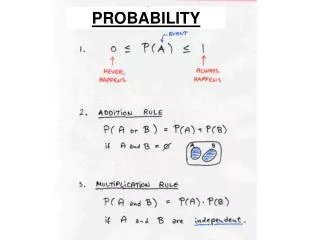
5.1 Basic Probability • Probability Defined: A Measure of Chance or, the likelihood of an event happening • ProbNotation: P(A) Probof event A “P of A” • Prob Found: # of desired results/# of total results f/n • 0<= P<=1
Complement • The complement of an event: P(not the event) P(not A). Written as P(A’) • P(A)+P(A’)=1… • So, P(A’)= 1-P(A)
Probvs Stat • Stats: the sample is known • We draw conclusions about the population based on the results of our sample. • Prob: the population is known • We ask “what are the chances…what is the likelihood on this try?” we are asking about this sample. • Stats reasons from the sample toward the population • Prob reasons from the population toward the sample