
Building Successful After-School Programs: Engaging Kids in Reading and Activities
E N D
Presentation Transcript
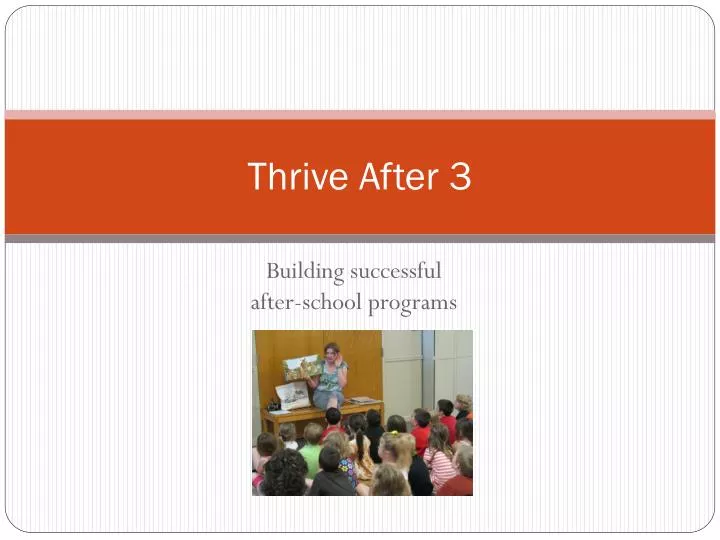
Thrive After 3 Building successful after-school programs
Plan after-school sessions • You already have a storytime audience, keep them coming back once the children enter school. • Plan 6-8 week sessions just like storytime: • Fall session: Mid-September to mid-November • Winter session: January-February • Spring session: March-April • This will give you May/June open to plan summer reading and get your school visits in.
When? • It may take some time to figure out what days and times work for your patrons. • Directly after-school? After dinner? Saturdays? • Do an informal survey with regular patrons. • Ask the school what days/times there are no school sports. • The School Calendar is your friend. Plan programs on half-days, professional development, parent conferences.
Marketing • Create flyers or brochures to pass out to the schools. Sometimes you need Superintendent/ Principal permission to distribute through the schools. • Market to parents. They’re looking for activities to improve their child’s life. Give them a reason! Parents sign their child up for soccer to learn team work, they’ll sign up for your program if they know the benefits of reading. • Market to both genders and all abilities.
How to build a successful program • Read the books! • Don’t assign homework. Kids have enough. • Don’t make it a book club. Save that for the summer reading program. • Mix it up with crafts, activities, games, competitions. • Create a 45-minute program • 15 mins of reading • 30 mins of activity
Set-Up • Just like storytime, have everything ready for the children. Put items on plates/cups, or bag everything up in sandwich baggies. This will alleviate fighting over colors and numbers of items.
Early Elementary (K-2 or K-3) • After School Adventurers • Super Sleuth Scholars • Story Crafters • Creative Characters • Chapter Masters • Genre Gobblers
Upper Elementary (3-5 or 4-6) • Mystery Mavens • Page Turners • Thinking Cap Society • Series Starters • Nutmeg Novelists
Budget & Funding • Start out using storytime supplies: photocopied paper, scissors, glue, crayons, markers, colored pencils. • As attendance grows, request more funding. • Apply for grants from Women’s Clubs, Veteran Clubs, Friends of the Library. • Don’t waste money on snacks. If your program is right after school, encourage children to bring their own snack they can eat when you read aloud.
Ideas for Future Programming • Read aloud winter program (Books & Chocolate) • If you get extra funding, provide hot cocoa or smores (Honey maid graham and chocolate graham with fluff is a peanut-free snack). • Run a 6-8 week program and provide a paperback copy of the book. • Lego Programs • This would be a one-time expense.
Additional Resources • Connecticut State Standards: • http://www.sde.ct.gov/sde/cwp/view.asp?a=2618&q=322592 • Common Core Standards: • http://www.corestandards.org/ • Lisa Shaia’s Series Programming for the School Aged Class offered by ALSC online: http://www.ala.org/alsc/edcareeers/profdevelopment/alscweb • Lisa’s blog: thriveafterthree.wordpress.com • Lisa’s forthcoming book: After-School Clubs to Encourage Reading ALA , September 2013