Managing Hyperkalemia in the Emergency Department
Learn about treating severe hyperkalemia with calcium, insulin, albuterol, and more. Understand causes, signs, symptoms, and treatment options for this electrolyte imbalance.

Managing Hyperkalemia in the Emergency Department
E N D
Presentation Transcript
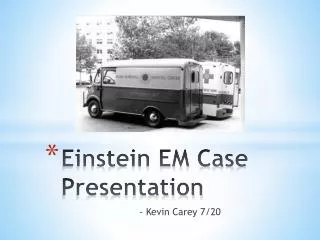
Einstein EM Case Presentation - Kevin Carey 7/20
CC: 67yo male BIBEMS after a social worker visited him and reported he was acting lethargic HPI: - Pt speaks slowly and appears lethargic but is A&Ox3 and doesn’t understand why the social worker activated EMS. - Has been drinking beer and vodka and abusing cocaine for several days. - Reports: falling and hitting his head 2x, having abdominal pain and a single episode of chest pain. - Denies: Current chest pain, SOB, headaches, episodes of NV, weakness PMHx:- HTN, CKD, Gout- Current Meds unknown-Soc: Denies IVDU Case History
V/S:- T: 97.2 HR: 105 BP: 79/53 RR: 15 O2: 99% on RA Exam:- Gen: Lethargic, slowly answers questions. Requires redirection- Neuro: A&O x 3, No focal deficits, gait not assessed- HENT: Dry mucus membranes, PERRL, EOMI-Cards: S1/S2, No MRG, No JVD- Pulm: CTAB- Abd: Soft, Non-tender, +BS- Ext: +1 Bilateral LE Edema, (No record of DTRs) Case Physical
Labs: WBC: 5.9H&H: 10.2/32.3Plts: 273 Na: 141K: 8.4Cl: 114CO2: 6.9BUN: 131Crea: 21 (Baseline 1.9)Glu: 120Gap: 20.1 LFTs: WNL UA: +Protein, - RBC, Nitrate LEFeNa: .5% Labs & EKG
Brief Potassium Physiology:- Relative concentrations of intra/extracellular potassium are the major determinants of electrochemical gradients in all living cells - 98% of the body’s potassium is intracellular- Extracellular K+ tightly regulated between 3.5-5.0mEq/L- 90% is renally excreted Causes:- Most frequently seen in ESRD patients who have missed dialysis appointments and patients w/ acute renal failure. - DKA, Rhabdomyolysis (Crush/Burn injuries),Severe Acidosis*Laboratory Hemolysis is the most common cause of an abnormal K+. Hyperkalemia
History: • Weakness, muscle cramps, paresthesias, N/V/D, & palpitations Physical: • Paresthesias, decreased strength, absence of DTRs • Audible arrhythmias • Hyperchloremic Metabolic Acidosis • EKG changes: • Typically occur at a plasma K > 6.5meq • Typical progression: 1) Peaked T-Waves (6.5 -7.5meq)2) Widening of the QRS (7.5 – 8.5meq)3) Loss of P Waves (7.5 – 8.5meq)4)Sine Waves / V-Fib (>10meq)5) Asystole **EKG changes can occur in any order and at varying potassium levels** Signs & Symptoms
Critical Care Medicine, 2008 Treating Severe Hyperkalemia
Who/When do we treat emergently? • Hemodynamically Unstable, EKG Changes or K+ > 6.5 • Suspected spike in K+: Crush injuries, tumor-lysis syndrome How do we treat? 1) Stabilization of the cardiac membrane 2) Redistribute extracellular K+ into cells 3) Eliminate K+ from the body Dispo: • Admission for cardiac and electrolyte monitoring and nephrology consult are required for moderate or severe cases • Home is only an option for mild cases where the patient is hemodynamically stable and has close outpatient follow-up Treatment Overview
Calcium has NO effect on Extracellular K • Calcium Stabilizes Cardiac Myocytes by: 1) Increasing the Threshold Potential 2) Restoring contractility/Vmax 3) Increasing Ca+, increases SA/AV signal propagation • Dosing and Duration- 1 amp of CaGluconate is given over 10min - Effect is theoretically immediate with EKG changes within 3 min- Lasts 30-60min Calcium & Cardiac Stabilization
Insulin-Effects seen within 20 min - Decreases K by 0.6-1.0 mEq/L for 4-6 hours-Given with a bolus of D50 in patients with a glucose < 250 Albuterol (Beta-Agonists)-Effects seen within 30min- Decreases K by 0.6-1.0 mEq/L for 2 hours*Albuterol and Insulin are synergistic and result in a reduction of ~1.2 - 1.5 mEq/L Bicarb- Not effective in reducing extracellular K+ - Should only be used to treat an underlying metabolic acidosis Potassium Redistribution
Furosemide- Onset in ~30min- Patients must be able to make urine Kayexalate- Most common treatment- Cation exchange resin which binds K+ in the gut and releases Na+- 1-2 hours to initial onset with 12 hour fecal potassium output ~31meq Hemodialysis- Most effective treatment. Can remove 25-50 meq per hour- HD the patient if the measures above are insufficient or the hyperkalemia is severe Elimination of Potassium
Dx: - Acute on Chronic Kidney Injury 2/2 hypovolemia and cocaine use ED Tx: - Pt received 2L NS, Calcium, Insulin, Kayexalate and a Bicarb drip Outcome: • K was reduced to 6.0 by the time he was transferred to the floor • Pt course complicated by ATN & DTs Our Patient
Who do we treat emergently? • Hemodynamically Unstable, EKG Changes, or K+ > 6.5 • Suspected spike in K+: Crush injuries, tumor-lysis syndrome What do we treat with? • Pneumonic: ABCDE • A: Albuterol • B: BiCarb • C: Calcium • D: Dextrose/Insulin, Diuretics, Dialysis • E: kayExalate Hyperkalemia Take-Aways
Weisberg, L. "Management of severe hyperkalemia" Critical Care Medicine 2008; 36: 3246-3251. Parham WA, Mehdirad AA, Biermann KM, Fredman CS. Hyperkalemia revisited. Tex Heart Inst J. 2006;33:40–7. AllonM, Copkney C. Albuterol and insulin for treatment of hyperkalemia in hemodialysis patients. Kidney Int 1990; 38:869. Mount, David B. Treatment and prevention of hyperkalemia. In: Up To Date, Travis, Anne. UpToDate, Waltham, MA 2012 References