Understanding Population Dynamics: Growth Patterns and Ecological Implications
This review explores the various aspects of population dynamics, including population size, density, growth rates, and reproductive strategies. It delves into concepts such as exponential and logistic growth, carrying capacity, and biotic potential, highlighting K-strategists and R-strategists. The impact of environmental resistance on population growth is discussed along with survivorship curves that illustrate mortality rates across different reproductive strategies. Additionally, the stages of demographic transition are outlined, showcasing the relationship between industrialization and changes in birth and death rates.

Understanding Population Dynamics: Growth Patterns and Ecological Implications
E N D
Presentation Transcript
Populations AP Environmental Review Caroline, Kristina, Lauren, Gwen, Colby
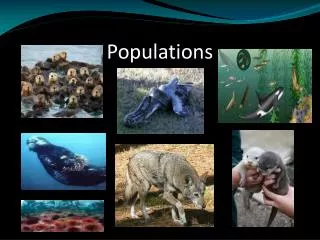
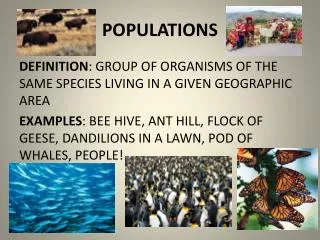
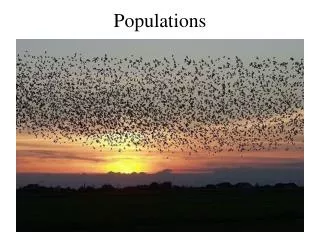
Populations… • All members of a species inhabiting a specific geographic area (at a time) • Size dictated by • Emigration • Immigration • Birth • Death
Density • Individuals in a population per unit habitat area • Dependent on • social/population structure • mating • time of year Density= • Distribution/Dispersion types • Random • Clumping – uneven groups • Uniform – rare, even
Exponential Growth • “Geometric” growth • J-shaped Curve • Starts slowly but then accelerates with population increase
Logistic Curve • S-shaped Curve • Begins exponential • Environmental resistance comes into play • Growth slows to accommodate carrying capacity (K)
Carrying Capacity (k) • Maximum number of species which may survive together at a given time • Determined by resources and biotic potential • Exceeding leads to a dieback or crash
Biotic Potential (r) • How a population might grow without presence of environmental resistance (limiting factors) • Density - independent • Exponential
K Strategists • Early reproduction • Large bounties of offspring • accounts for high instance of death • Little care provided • Generally lower tropic levels
R Strategists • Reproduce later in life • Few offspring • Large energy input for care • More prone to extinction • More specialized
Survivorship Curves • Show the number/proportion of group individuals surviving at specific ages • Reflection of reproductive strategies • I. Late loss: K-strategist that produce few young and care for them until they reach reproductive age, reducing juvenile mortality. • II. Constant loss: Intermediate reproductive strategist with fairly constant mortality. • III. Early loss: r- strategists with high infant mortality
Standard Growth Rate (r)=*100
Other Growth Rates • Crude birth rate • live births occurring (per 1,000) in given time CBR = • Crude death rate • amount of deaths (per 1,000) in given time CDR= • Doubling Time (Rule of 70) • Time it would take for a population to double in size 70/r
Total Fertility Rate (TFR) • Average offspring a woman will have in her lifetime • Replacement Fertility Rate • Number of children which must be born to replace those creating them
Zero Growth • The ultimate goal of a population • Occurs at two phases • When both rates (birth/death) are equally high • When both are equally low (birth+ immigration)= (death+ emigration)
Rapid Growth • Appears “bottom-heavy” • Large portion of population which will soon move to the reproductive stage • Slow Growth • General evenness with growth • Negative Growth • Large portion of population post-reproductive • Small portion to move into reproductive
Human Population Numbers vary according to Industrialization
Demographic Transitions • Societal change in birth and death rates • Both change as industrialization develops
Stage 1: Pre Industrial • Slow population growth • Due to high birth rate and high death rate • Living conditions are poor
Stage 2: Transitional • Improvements bring a decline in death rate • Medical, sanitation, food • Birth rate remains high • Rapid population growth
Stage 3: Industrial • Birth rate slows • Due to further innovation • Meets death rate • General growth slows
Stage 4: Post-Industrial • Birth rate falls below death • Zero population growth