Enhancing Traffic Management with Overhead Travel Time Messaging: A Comprehensive Analysis
This report by Brian Kary and Terry Haukom discusses the implementation and effectiveness of posting travel time information on overhead electronic signs. It highlights how providing delay information can aid motorists in making diversion decisions and presents results from perception tracking surveys regarding travel time messages. The findings indicate that a significant portion of drivers view these messages as valuable, with many indicating they have altered their routes based on the information provided. The integration of advanced detection methods and existing infrastructure is also explored to improve traveler information systems.

Enhancing Traffic Management with Overhead Travel Time Messaging: A Comprehensive Analysis
E N D
Presentation Transcript
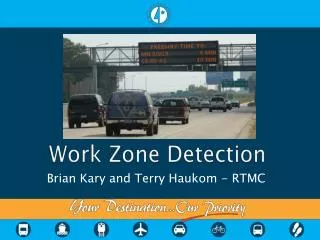
Work Zone Detection Brian Kary and Terry Haukom- RTMC
Why Do It • Provide Delay Information To Motorists • Potential for Diversion • Perception Tracking Survey Results
Travel Time Messages – Ratings & Comments Q71d. How would you rate the idea of posting travel TIME information on overhead electronic signs as a tool to manage traffic? All Drivers • Overall, drivers continue to consider displaying travel time information on overhead electronic signs to be a good idea. • There is a significant increase in the proportion of drivers who consider displaying travel time messages an “Excellent” idea. N = Base # = Frequency Data noted with arrow is significantly lower or higher respectively than 2011 at the 95% confidence level. *Totals may not equal 100% due to rounding. Mean = 8.19 Mean = 8.12
Travel Time Messages - Actionability Q71b. How often, if at all, do you take an ALTERNATE ROUTE because a travel time message on an overhead electronic message sign showed a longer time than your usual time for the trip? • Among those drivers who make a route decision based on a travel time message, nearly 6 in 10 chose to take an alternate route at least some of the time. Have Made an Alternate Route Decision Based on Time Message Info 58% N = Base # = Frequency *Totals may not equal 100% due to rounding. Data noted with arrow is significantly lower or higher respectively than 2011 at the 95% confidence level.
Why Integrate with RTMC? • Proven Method of Calculating Travel Times • Reduced Costs • Utilize existing 150+ DMS • Utilize detection outside of work zone • Currently have 400 miles of freeway instrumented with loop detection • Future detection will utilize more Wavetronics sensors which may allow detection within work zones • Traveler Information
Traveler Information • Traveler Information Websites • Smart Phone Apps
Traveler Information • Traffic Reports • Travel Times Signs
Detection Trailer • Wavetronics Sensor • Camera • Wireless Modem • Solar Power
Travel Time Zone Distance Between Stations = ½ mile Distance Between Stations = ½ mile Error Caused by Increased Spacing Between 55 MPH and 5 MPH
Past Projects • Included in Main Project – Lump Sum • I-35E – From CR 96 to I-35 • $250,000 • I-694 – From Hwy 61 to Hwy 5 • $185,000 • Separate Project • I-494 – From Hwy 100 to 34th Ave (SP 2785-392) • $262,300
Issues with Past Projects • Not enough lead time for integration • Lack of communications about traffic switches • Inadequate detection methods • Increased detection spacing • Probe data
Metro Wide Project - SP 8825-465 • Total Project Estimated Cost - $750,000 • Provide one prototype trailer. • SP 0285-65 on I-694 from Hwy 252 to I-35W. • Provide 16 trailers. • SP 1982-161 on I-35E from I-35 south split to Cliff Rd. • Provide 8 trailers. • SP 2776-103 Hwy 169 River Bridge. • Provide 18 trailers plus 3 PCMS. • SP 7080-51, 7080-50 on I-35 from District Border to I-35 south split. • Provide 30 trailers which includes 3 w/ cameras plus 3 PCMS.
Questions?Brian KaryFreeway Operations Engineerbrian.kary@state.mn.usTerry HaukomRTMC Design and Maintenance Supervisorterry.haukom@state.mn.us