Understanding Electric Potential: Concepts of Work and Energy in Electric Fields
This article explores the fundamental concepts of electric potential, work, and energy within electric fields. It explains how electric potential energy varies with position and how it relates to charge in a uniform electric field. The work done by an electric field when moving a charge is defined, and the relationship between electric potential, electric field, and equipotential surfaces is discussed. Additionally, it highlights the significance of these principles in practical scenarios, including lightning safety and the behavior of conductors.


Understanding Electric Potential: Concepts of Work and Energy in Electric Fields
E N D
Presentation Transcript
Electric Potential another useful concept
Electrical work • A field does work when it moves a charge. Dx Work done by field= qEDx along a uniform field
Electrical work • Charge has different potential energy Uat different locations Dx –DU = Work done by field = qEDx • Potential energy is proportional to charge
Electric Potentiale • Potential energy per unit charge e = U/q • Depends on position • Scalar quantity • Unit = J/C = V = volt
Electric Potential What is the work required to move a charged object through a field? higher e lower e Dx Work = qE·Dx = D(U) = qDe e = electric potential = U/unit charge
It makes sense from the relationships between • Electric field and electric force • Electric potential and electric potential energy • Work and potential energy • Force and work Potential and Field • Equipotential surfaces are always perpendicular to electric field lines/vectors. Why? • Potential changes rapidly where field is strong. Why?
Group Work • Draw field lines and equipotential surfaces around a pair of opposite charges. • Draw field lines and equipotential surfaces around a pair of equal charges.
Electric Potential e • DU = Ufinal – Uinitial • De = efinal – einitial
Potential is path-independent • De from a to b is the same for all paths b a
Question An infinite, uniformly positively-charged plane produces a uniform electric field. How does the electric potential change with increasing distance from the plane? Potential increases. Potential decreases. Potential is constant. + + x + + +
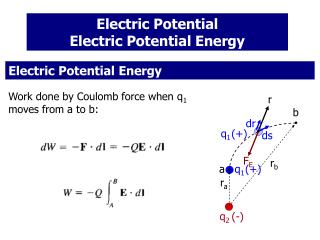
d q1 q2 kq1 kq1q2 • Result: W = ; e= d d Potential around a point charge • Convention: e = 0 at d= • So, e(r) = work/charge to bring charge from to d
Potential of Conductors At electrostatic equilibrium: • Field is zero inside conductor • potential is constant Zero net force on all charges
Lightning Safety This is why a car is a good place to be in a thunderstorm. • No electric field inside • No reason for charges to move through you
The Electron Volt eV • Unit of energy • eV = (Elementary charge e) · 1 volt • Compare to Joule = (1 C)(1 V) • e = 1.60210–19 C, so eV = 1.60210–19 J
Question An infinite, uniformly positively-charged plane produces a uniform electric field. If the potential is V(d) a distance d from the plate, what is the potential at infinite distance? V(d) Potential is +. Potential is zero. Potential is –. + + d + + +