IP Address Allocation for Point-to-Point and Local Area Networks
This document outlines the process of allocating IP addresses within a specified address space (10.38.161.0 - 10.38.161.67) for three point-to-point networks and three local area networks. It details the necessary calculations for the required address space for each network, the size of address blocks, and how to determine subnet masks. The document explains step-by-step how to allocate addresses from Router R3 and addresses the common pitfalls in determining network addresses and broadcast addresses.

IP Address Allocation for Point-to-Point and Local Area Networks
E N D
Presentation Transcript
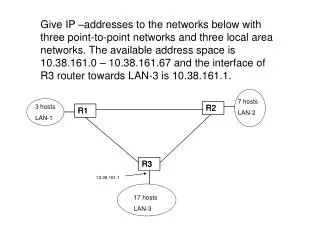
Give IP –addresses to the networks below with three point-to-point networks and three local area networks. The available address space is 10.38.161.0 – 10.38.161.67 and the interface of R3 router towards LAN-3 is 10.38.161.1. 7 hosts LAN-2 3 hosts LAN-1 R2 R2 R1 R1 R3 R3 10.38.161.1 17 hosts LAN-3
SOLUTION: 1. Find the point-to-points networks and the local networks. 2. Define the address space needed in each network (how many interfaces?) 3. What is the size of the block (power of 2)? 4. Start allocating the IP –addresses from R3 (10.38.100.1). 5. What is the mask? 6. Remember the rule: network address/number of addresses in the network = Interger Remarks: Address 10.38.100.12/28 (or 255.255.255.240) cannot be a network address. Why not? How to calculate the network address and broadcast address?
SOLUTION 1. Find the point-to-points networks and the local networks. R1-R2 R2 3 hosts R1 7 hosts LAN-1 LAN-2 R1-R3 R2-R3 R3 17 hosts LAN-3
SOLUTION 2. Define the address space needed in each network (how many interfaces?) 3. What is the size of the block (power of 2)? LAN-3: 17 hosts+NWA+BCA+R3-interface=20 32 addr (5 bits) LAN-2: 7 hosts+1+1+1=10 16 addr (4 bits) LAN-1: 3 hosts+1+1+1=6 8 addr (3 bits) R1-R2: 2 hosts+1+1=4 4 addr (2 bits) R1-R3: 2+1+1=4 4 addr (2 bits) R2-R3: 2+1+1=4 4 addr (2 bits) 0 31|32 47|48 55|56 59|60 63|64 67| 32 addresses 16 addr 8 addr 4 a. 4 a. 4 a.
SOLUTION:4. Start allocating the IP –addresses from R3 (10.38.100.1). 5. What is the mask? LAN-3: 10.38.100.0 10.38.100.31 (mask 27 or 255.255.255.224) 32 addr LAN-2: 10.38.100.32 10.38.100.47 (mask 28 or 255.255.255.240) 16 addr LAN-1: 10.38.100.48 10.38.100.55 (mask 29 or 255.255.255.248) 8 addr RI-R2: 10.38.100.56 10.38.100.59 (mask 30 or 255.255.255.252) 4 addr RI-R3: 10.38.100.60 10.38.100.63 (mask 30 or 255.255.255.252) 4 addr R2-R3: 10.38.100.64 10.38.100.67 (mask 30 or 255.255.255.252) 4 addr totally 68 addr 6. Remember the rule: network address/number of addresses in the network = Interger LAN-3: 0/32=0Integer R1-R2: 56/4=14Integer LAN-2: 32/16=2Integer R1-R3: 60/4=15Integer LAN-1: 48/8=6Integer R2-R3: 64:4=16Integer
Address 10.38.100.12/28 (or 255.255.255.240) cannot be a network address. Why not? Mask=28 28 bits for network 32-28=4 bits for hosts16 addr NWA/addresses 12/16 NOT Integer
How to calculate the network address and broadcast address? 10.38.100.12/28 = 10.38.100.12/255.255.255.240 0 0 0 0 1 1 0 0 = 12 AND 1 1 1 1 0 0 0 0 = 240 mask 0 0 0 0 0 0 0 0 = 0 NWA OR 0 0 0 0 1 1 1 1 = INV mask 0 0 0 0 1 1 1 1 = 15 BCA
Suppose we think that 12 is NWA and mask is 28. There are 4 bits available for hosts =16 addr (015). 0 0 0 0 1 1 0 0 = 12 0 0 0 0 1 1 0 1 = 13 0 0 0 0 1 1 1 0 = 14 0 0 0 0 1 1 1 1 = 15 0 0 0 1 0 0 0 0 = 16 needs 5 bits etc. etc.