Understanding Blood Components and Their Functions in the Human Body
150 likes | 298 Vues
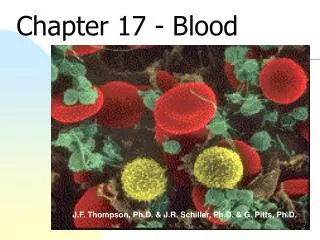
Blood is vital for various physiological processes, comprising plasma, red blood cells, white blood cells, and platelets. Its primary functions include the exchange of substances, transport of nutrients and gases, buffering against pH changes, maintaining body temperature, hemostasis, and defense against pathogens. The average blood volume ranges from 70-80 ml/kg, constituting 7-8% of body weight. Key characteristics such as hematocrit levels, viscosity, and osmolality provide insights into blood's physical and chemical properties, elucidating its role in homeostasis and overall health.


Understanding Blood Components and Their Functions in the Human Body
E N D
Presentation Transcript
Chapter 3 Blood Section 1 Blood components and its properties
Functions of blood 1. Place of exchange of substances between interstitial fluid and external environment 2. Transport 3. Buffer function 4. To keep body temperature relatively constant 5. Hemostasis止血 6. Defense function
1. Components of blood plasma blood cells: red blood cells (erythrocytes) white blood cells platelets Blood volume: 70-80ml/Kg, 7-8% of body weight
Hematocrit血细胞比容 men is about 40~50%, women is about 37~48%.
2. Physical and chemical propertiesof blood (1) Specific gravity 比重 blood: 1.050~1.060. RBC number plasma: 1.025~1.030. Content of plasma proteins RBC:1.090 ~1.092. hemoglobin
(2) Viscosity粘性Viscosity of plasma is 1.2-1.3 times that of water, viscosity of whole blood is 2.4 times of plasma.
Osmotic pressure is determined by the number of particle, instead of the mass of the solute..
At 37℃, 1 osmolality will cause 19300 mmHg osmotic pressure.Plasmaosmolality is 0.313Osm /Kg. H20 0.313×19300 = 5330 mmHg
Colloid胶体 osmotic pressure: maintain intra-and extra-capillary water equilibrium Crystal晶体 osmotic pressure: maintain intra-and extracellular water equilibrium
Isoosmotic solution等渗hyperosmotic solutionhypoosmotic solutionIsotonic solution等张
3. RBC fragility. 0.42% NaCl solution--begin hemolysis溶血 0.35%NaCl solution--complete hemolysis 4. Plasma pH 7.35-7.45