Understanding the Modern Periodic Table: Structure and Properties of Elements
80 likes | 188 Vues
The modern periodic table, organized by atomic number rather than atomic mass, reflects the Periodic Law, where elements display recurrent chemical and physical properties. This structure groups elements with similar characteristics, particularly the noble gases in Group 18, known for their stability due to full electron shells. Valence electrons, particularly crucial in determining an element's chemical properties, are also explored. The periodic patterns in electron configurations are essential for understanding the behavior of elements across the table.


Understanding the Modern Periodic Table: Structure and Properties of Elements
E N D
Presentation Transcript
Periodic Table Chemistry 11
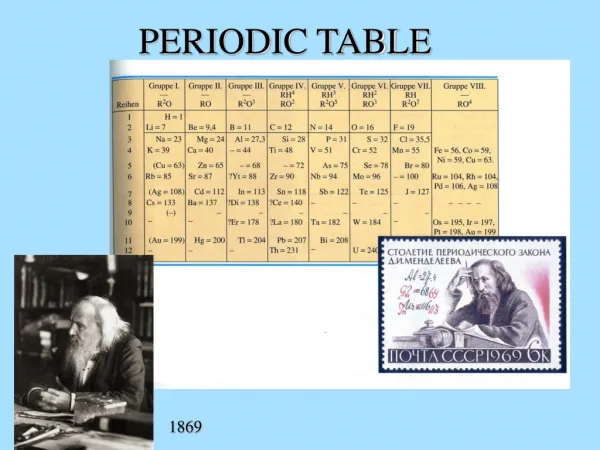
The Periodic Table • Began with Mendeleev • Sequenced elements based on increasing atomic mass • Additionally, elements with similar properties were grouped together
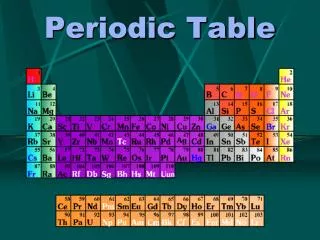
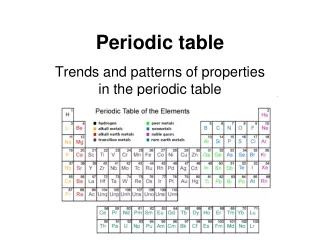
Modern Periodic Table • Instead of using Atomic Mass, the table is organized by Atomic Number • According to Periodic Law • The chemical and physical properties of the elements repeat in a regular, periodic pattern when they are arranged according to their atomic number
Electrons and the Periodic Table • The Noble Gases (Group 18 or VIIIA) are so named because they are very stable • They do not react under most conditions because they are understood to have a full outer shell of electrons • Use the number of electrons in each Noble Gas to determine the number of electrons to fill each electron shell
Noble Gas He Ne Ar Kr Xe Rn Uuo Electrons 2 10 18 36 54 86 118 Electrons and the Periodic Table • Valence Electrons • 2 • 8 • 8 • 18 • 18 • 32 • 32
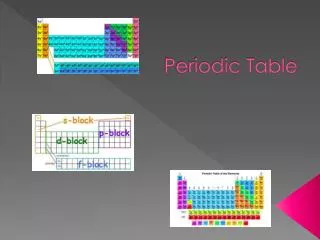
Valence Electrons • The number of electrons in the outer shell are known as the Valence Electrons • The number of Valence Electrons an atom has determines, in large part, its chemical properties • Based upon the patterns of Valence Electrons, the Periodic Table can be displayed as seen on page 19
Problems • Practice Problems 7 & 8 Page 20 • Section Review 1-7 Pages 20-21