
SlideServe
Menu
Préférences
© SlideServe · v2026

Hydrogen

avari avatar
17 diapositives · 510 Views · Oct 01, 2014

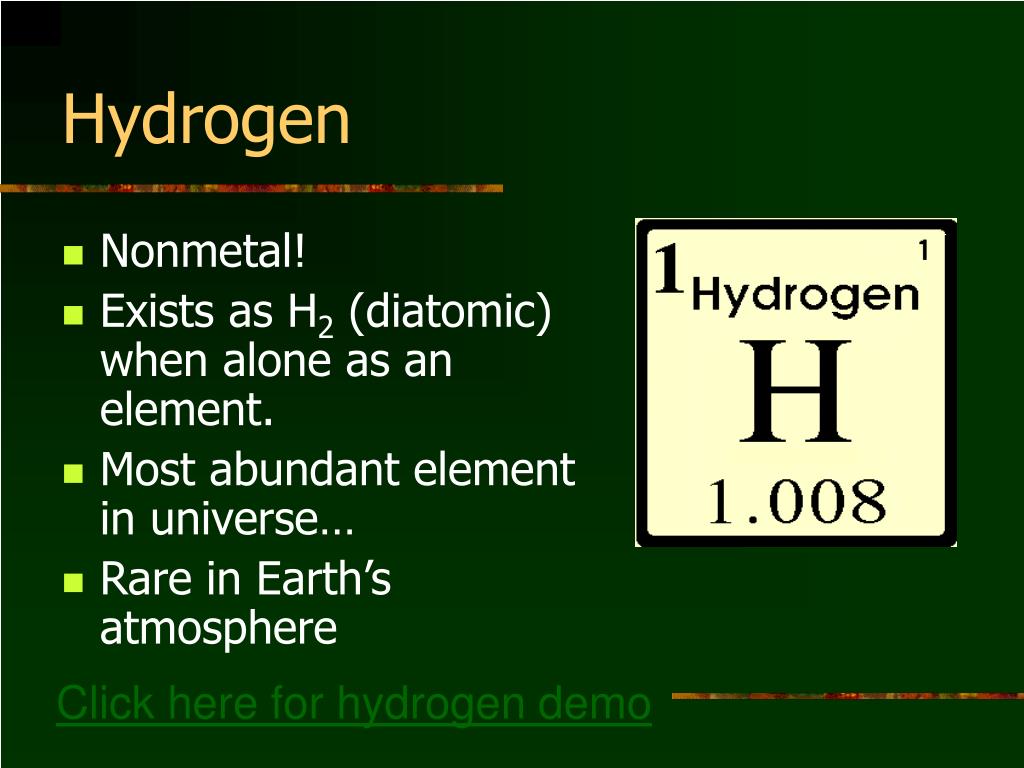
Hydrogen. Nonmetal! Exists as H 2 (diatomic) when alone as an element. Most abundant element in universe… Rare in Earth’s atmosphere. Click here for hydrogen demo. Alkali Metals. Group 1 (1A) Properties of all metals… Shiny & Good Conductors Malleable – can be hammered into thin sheets.
Hydrogen - slide 1
01 / 17Hydrogen
1 / 17

Télécharger la présentation

Hydrogen
Une image / un lien ci-dessous est fourni (tel quel) pour télécharger la présentation

Politique de téléchargement : le contenu du site vous est fourni TEL QUEL pour votre information et votre usage personnel ; il ne peut être vendu, concédé sous licence ni partagé sur d’autres sites sans l’accord de son auteur.Le contenu vous est fourni TEL QUEL, pour votre information et votre usage personnel uniquement. Téléchargez la présentation en cliquant sur ce lien. Lors du téléchargement, si vous ne parvenez pas à télécharger une présentation, l’éditeur a peut-être supprimé le fichier de son serveur.Pendant le téléchargement, si vous ne parvenez pas à obtenir une présentation, le fichier a peut-être été supprimé par l’éditeur.

F I N

Plus de contenu associé

Transcription de la présentation
  1. Hydrogen • Nonmetal! • Exists as H2 (diatomic) when alone as an element. • Most abundant element in universe… • Rare in Earth’s atmosphere Click here for hydrogen demo

  2. Alkali Metals • Group 1 (1A) • Properties of all metals… • Shiny & Good Conductors • Malleable – can be hammered into thin sheets. • Ductile – can be drawn into thin wires. [http://wps.prenhall.com/wps/media/objects/602/616516/Media_Assets/Chapter01/Text_Images/FG01_02-04UN.JPG]

  3. Alkali Metals • Low density and melting points. • Soft and silver-white in color • Highly unstable elements that are not found pure in nature. [http://www.microchem.de/elec000a-k.JPG]

  4. Alkali Metals • All form +1 ions. • Most reactive metals on table (low ionization energy) and this increases from Li to Fr. Click here for Alkali Metals & Water Demos [http://wps.prenhall.com/wps/media/objects/476/488316/Instructor_Resources/Chapter_09/FG09_33.JPG]

  5. Alkaline Earth Metals • Group 2A • Higher density and M.P. than Alkali Metals. [http://wps.prenhall.com/wps/media/objects/602/616516/Media_Assets/Chapter01/Text_Images/FG01_02-04UN.JPG]

  6. Alkaline Earth vs. Alkali Metals [http://wps.prenhall.com/wps/media/objects/602/616516/Media_Assets/Chapter06/Text_Images/FG06_TB05.JPG]

  7. Alkaline Earth Metals • More of a silver-metallic color for this group. • Also highly reactive in nature, but can be stored as an element. [http://www.chemsoc.org/viselements/pages/data/graphic/ca_data.jpg]

  8. Alkaline Earth Metals • All form +2 ions. Click here for videos on the Alkaline Earth Metals [http://wps.prenhall.com/wps/media/objects/476/488316/Instructor_Resources/Chapter_09/FG09_34.JPG]

  9. p-Block Groups • Groups 13-16 named after the first element. • Boron Group 13 (3A) • +3 ions

  10. [http://wps.prenhall.com/wps/media/objects/602/616516/Media_Assets/Chapter19/Text_Images/FG19_TB03.JPG][http://wps.prenhall.com/wps/media/objects/602/616516/Media_Assets/Chapter19/Text_Images/FG19_TB03.JPG]

  11. p-Block Groups • Carbon Group 14 (4A) • No ion pattern because all have 4 valence electrons [http://wps.prenhall.com/wps/media/objects/602/616516/Media_Assets/Chapter19/Text_Images/FG19_02-09UN.JPG]

  12. p-Block Groups Nitrogen Group (-3 ions) Oxygen Group (-2 ions) [http://wps.prenhall.com/wps/media/objects/602/616516/Media_Assets/Chapter19/Text_Images/FG19_02-09UN.JPG]

  13. p-Block Groups • Both Nitrogen and Oxygen are diatomic as elements (N2 & O2)

  14. Halogens • Group 17 (7A) • Some are diatomic when alone as an element. [http://wps.prenhall.com/wps/media/objects/602/616516/Media_Assets/Chapter01/Text_Images/FG01_02-04UN.JPG]

  15. The “Super Seven” are all diatomic when alone as elements!

  16. Halogens • Exist as gas, liquids, and solids with distinct colors.

  17. Halogens • Most reactive non-metals on table and increases from I To F. • All form –1 ions. • Most form salts by combining with alkali metals. (+1 ion with –1 ion) Click here for Halogen reactivity video Click here for videos on the Halogens