The Fall of Rome: Internal Weaknesses and External Threats
90 likes | 227 Vues
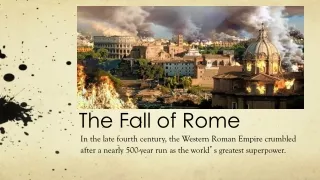
The decline of the Roman Empire was marked by internal weaknesses and civil wars that undermined unity. Power shifted to legions loyal for profit rather than legitimacy, with mercenaries overtaking citizen soldiers. Constant front-line warfare drained resources, leading to inflation and piracy. Attempts at reform under Diocletian and Constantine sought to stabilize the empire but faced challenges. External pressures from migrating tribes, particularly the Huns and Germanic leaders who understood Roman strategy, culminated in invasions that ultimately led to the fall of the Western Empire in 476 CE.


The Fall of Rome: Internal Weaknesses and External Threats
E N D
Presentation Transcript
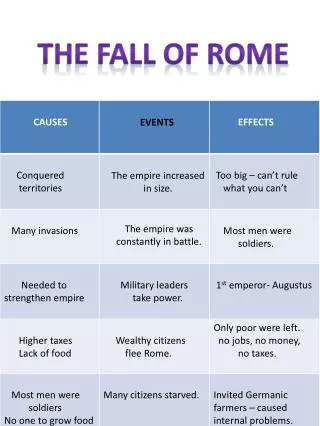
Internal Weaknesses • Civil Wars robbed the Empire of unity • Power became based on loyalty of legions rather than legitimacy • The legions had more mercenaries than citizens with no attachment to Rome
Internal Weaknesses • Constant warfare on the frontiers were expensive • Extra legions had to be raised and paid for • Legions based on the frontier made Italy vulnerable to invasions
Internal Weaknesses • Constant turmoil meant an increase in piracy and banditry • Commerce decreased causing a need for higher taxes • Inflation caused unrest in Rome
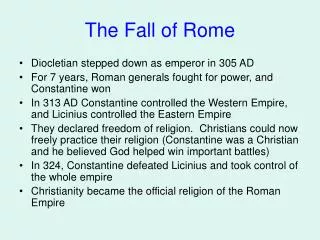
Attempts at Reform • Diocletian • Absolute monarchy • Divided the empire • Rigid social classes • State direction of economy • New tax system • Emphasis on defense of the empire
Attempts at Reform • Constantine • Supported Christianity • Created a new capital at Byzantium called Constantinople • More wealth in the east
External Threats • Movement of peoples from Central Asia pressured Germanic tribes • Germanic tribes moved into the empire • German leaders knew Roman tactics from time in the legions
Invasion • Huns invaded into Gaul weakened the west • Germanic tribes started controlling western provinces • Ostrogoths & Vandals attacked Rome • 476 CE Odoacer defeated the last Western Emperor
Byzantine Empire • The Eastern Roman empire survived because of greater wealth • Increasing Greek influence made it different than Rome • Later period called the Byzantine Empire from site of Constantinople