SlideServe
Menu
Préférences
© SlideServe · v2026

35 th International Colloquium on Automata, Languages and Programming July 8, 2008

aviva avatar
72 diapositives · 880 Views · Sep 16, 2014

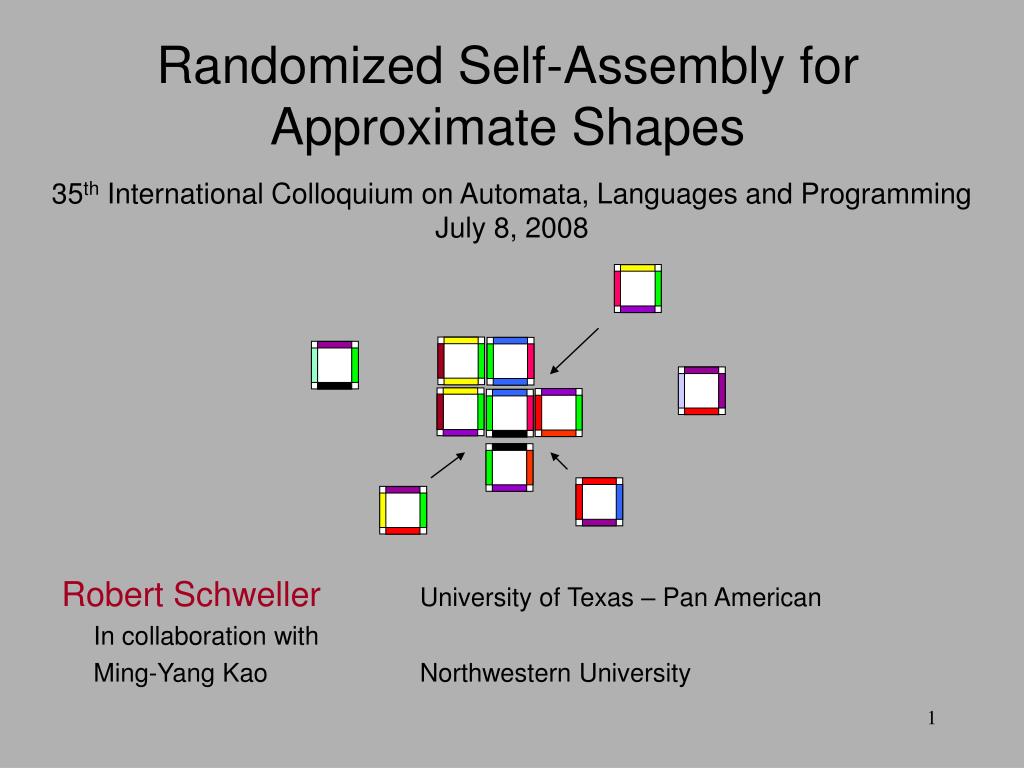
Randomized Self-Assembly for Approximate Shapes. 35 th International Colloquium on Automata, Languages and Programming July 8, 2008. Robert Schweller University of Texas – Pan American In collaboration with Ming-Yang Kao Northwestern University. Outline. Assembly Model

35 th International Colloquium on Automata, Languages and Programming July 8, 2008 - slide 1
01 / 7235 th International Colloquium on Automata, Languages and Programming July 8, 2008
1 / 17

Télécharger la présentation

35 th International Colloquium on Automata, Languages and Programming July 8, 2008
Une image / un lien ci-dessous est fourni (tel quel) pour télécharger la présentation

Politique de téléchargement : le contenu du site vous est fourni TEL QUEL pour votre information et votre usage personnel ; il ne peut être vendu, concédé sous licence ni partagé sur d’autres sites sans l’accord de son auteur.Le contenu vous est fourni TEL QUEL, pour votre information et votre usage personnel uniquement. Téléchargez la présentation en cliquant sur ce lien. Lors du téléchargement, si vous ne parvenez pas à télécharger une présentation, l’éditeur a peut-être supprimé le fichier de son serveur.Pendant le téléchargement, si vous ne parvenez pas à obtenir une présentation, le fichier a peut-être été supprimé par l’éditeur.

F I N

Plus de contenu associé

Transcription de la présentation
  1. Randomized Self-Assembly for Approximate Shapes 35th International Colloquium on Automata, Languages and Programming July 8, 2008 • Robert SchwellerUniversity of Texas – Pan American • In collaboration with • Ming-Yang KaoNorthwestern University

  2. Outline • Assembly Model • Basic Constructions • Probabilistic Assembly Model • Main Result

  3. Tile Assembly Model (Rothemund, Winfree, Adleman) G(y) = 2 G(g) = 2 G(r) = 2 G(b) = 2 G(p) = 1 G(w) = 1 t = 2 T = Glue Function: Tile Set: Temperature: Seed Tile:

  4. Tile Assembly Model (Rothemund, Winfree, Adleman) G(y) = 2 G(g) = 2 G(r) = 2 G(b) = 2 G(p) = 1 G(w) = 1 t = 2 T =

  5. Tile Assembly Model (Rothemund, Winfree, Adleman) G(y) = 2 G(g) = 2 G(r) = 2 G(b) = 2 G(p) = 1 G(w) = 1 t = 2 T =

  6. Tile Assembly Model (Rothemund, Winfree, Adleman) G(y) = 2 G(g) = 2 G(r) = 2 G(b) = 2 G(p) = 1 G(w) = 1 t = 2 T =

  7. Tile Assembly Model (Rothemund, Winfree, Adleman) G(y) = 2 G(g) = 2 G(r) = 2 G(b) = 2 G(p) = 1 G(w) = 1 t = 2 T =

  8. Tile Assembly Model (Rothemund, Winfree, Adleman) G(y) = 2 G(g) = 2 G(r) = 2 G(b) = 2 G(p) = 1 G(w) = 1 t = 2 T =

  9. Tile Assembly Model (Rothemund, Winfree, Adleman) G(y) = 2 G(g) = 2 G(r) = 2 G(b) = 2 G(p) = 1 G(w) = 1 t = 2 T =

  10. Tile Assembly Model (Rothemund, Winfree, Adleman) G(y) = 2 G(g) = 2 G(r) = 2 G(b) = 2 G(p) = 1 G(w) = 1 t = 2 T =

  11. Tile Assembly Model (Rothemund, Winfree, Adleman) G(y) = 2 G(g) = 2 G(r) = 2 G(b) = 2 G(p) = 1 G(w) = 1 t = 2 T =

  12. Tile Assembly Model (Rothemund, Winfree, Adleman) G(y) = 2 G(g) = 2 G(r) = 2 G(b) = 2 G(p) = 1 G(w) = 1 t = 2 T =

  13. How efficiently can you build an n x n square? s

  14. How efficiently can you build an n x n square? n s

  15. How efficiently can you build an n x n square? Tile Complexity: 2n n x s

  16. How efficiently can you build an n x n square? s

  17. How efficiently can you build an n x n square? -Use log n tile types to seed counter: 0 0 0 0 s log n

  18. How efficiently can you build an n x n square? -Use log n tile types capable of Binary counting: -Use 8 additional tile types capable of binary counting: 0 0 0 0 s log n

  19. How efficiently can you build an n x n square? -Use log n tile types capable of Binary counting: -Use 8 additional tile types capable of binary counting: 1 1 0 0 1 0 0 0 0 1 1 1 0 1 1 0 0 1 0 1 0 1 0 0 0 0 1 1 0 0 1 0 0 0 0 1 0 0 0 0 s log n

  20. How efficiently can you build an n x n square? -Use log n tile types capable of Binary counting: -Use 8 additional tile types capable of binary counting: 1 1 1 1 1 1 1 0 1 1 0 1 1 1 0 0 1 0 1 1 1 0 1 0 1 0 0 1 1 0 0 0 0 1 1 1 0 1 1 0 0 1 0 1 0 1 0 0 0 0 1 1 0 0 1 0 0 0 0 1 0 0 0 0 s log n

  21. How efficiently can you build an n x n square? -Use log n tile types capable of Binary counting: -Use 8 additional tile types capable of binary counting: 1 1 1 1 1 1 1 0 1 1 0 1 1 1 0 0 1 0 1 1 1 0 1 0 1 0 0 1 1 0 0 0 0 1 1 1 0 1 1 0 0 1 0 1 0 1 0 0 0 0 1 1 0 0 1 0 0 0 0 1 0 0 0 0 s 0 0 0 0 0 0 0 0 1 1 1 1 1 1 1 1 0 0 0 0 1 1 1 1 0 0 0 0 1 1 1 1 0 0 1 1 0 0 1 1 0 0 1 1 0 0 1 1 0 1 0 1 0 1 0 1 0 1 0 1 0 1 0 1

  22. How efficiently can you build an n x n square? 1 1 1 1 Tile Complexity: O(log n) 1 1 1 0 1 1 0 1 (Rothemund, Winfree 2000) 1 1 0 0 1 0 1 1 1 0 1 0 n – log n With optimal counter: Tile Complexity: O(log n / loglog n) 1 0 0 1 1 0 0 0 0 1 1 1 0 1 1 0 0 1 0 1 x 0 1 0 0 (Adleman, Cheng, Goel, Huang 2001) 0 0 1 1 0 0 1 0 0 0 0 1 Meets lower bound: W(log n / loglog n) 0 0 0 0 s 0 0 0 0 0 0 0 0 1 1 1 1 1 1 1 1 log n 0 0 0 0 1 1 1 1 0 0 0 0 1 1 1 1 y 0 0 1 1 0 0 1 1 0 0 1 1 0 0 1 1 (Rothemund, Winfree 2000) 0 1 0 1 0 1 0 1 0 1 0 1 0 1 0 1

  23. Outline • Assembly Model • Basic Constructions • Probabilistic Assembly Model • Main Result

  24. Probabilistic Assembly Model S a b c (Becker, Remila, Rapaport) Assign Relative Concentrations: %5 %5 x d %5 %60 %5 %20

  25. Probabilistic Assembly Model S S x a b c (Becker, Remila, Rapaport) Tileset = d %5 %5 %5 %60 %20 %5 G(y) = 2 G(g) = 2 G(r) = 2 G(p) = 1 G(w) = 1 t = 2

  26. Probabilistic Assembly Model S S x a b c (Becker, Remila, Rapaport) Tileset = d %5 %5 %5 %60 d %20 %5 G(y) = 2 G(g) = 2 G(r) = 2 G(p) = 1 G(w) = 1 t = 2

  27. Probabilistic Assembly Model S S x a a b c (Becker, Remila, Rapaport) Tileset = d %5 %5 %5 %60 d %20 %5 G(y) = 2 G(g) = 2 G(r) = 2 G(p) = 1 G(w) = 1 t = 2

  28. Probabilistic Assembly Model S S x a a b c (Becker, Remila, Rapaport) Tileset = d %5 %5 %5 %60 x d %20 %5 G(y) = 2 G(g) = 2 G(r) = 2 G(p) = 1 G(w) = 1 t = 2

  29. Probabilistic Assembly Model S S S x a a b c (Becker, Remila, Rapaport) Tileset = d %5 %5 %5 %60 x d d %20 %5 G(y) = 2 G(g) = 2 G(r) = 2 G(p) = 1 G(w) = 1 t = 2

  30. Probabilistic Assembly Model S S S x a a b b c (Becker, Remila, Rapaport) Tileset = d %5 %5 %5 %60 x d d %20 %5 G(y) = 2 G(g) = 2 G(r) = 2 G(p) = 1 G(w) = 1 t = 2

  31. Probabilistic Assembly Model S S S x a a b b c c (Becker, Remila, Rapaport) Tileset = d Two Terminal Shapes Produced %5 %5 %5 %60 x d d %20 %5 G(y) = 2 G(g) = 2 G(r) = 2 G(p) = 1 G(w) = 1 t = 2

  32. Probabilistic Assembly Model S S S S S x d a a b b c (Becker, Remila, Rapaport) Tileset = d .60/.85 = %70.6 .20/.85 = %23.5 %5 %5 .05/.85 = %5.9 %5 %60 %20 %5 G(y) = 2 G(g) = 2 G(r) = 2 G(p) = 1 G(w) = 1 t = 2

  33. Probabilistic Assembly Model S S S S S S S S S x x d d d d d a a a a b b b b c c (Becker, Remila, Rapaport) Tileset = d %23.5 %70.6 %5.9 %5 %5 %5 %60 %20 %5 G(y) = 2 G(g) = 2 G(r) = 2 G(p) = 1 G(w) = 1 t = 2 %75 %25

  34. Generic Tileset for all Squares

  35. Generic Tileset for Approximate Squares n (1+e)n (1-e)n

  36. Generic Tileset for Approximate Squares (e , d) – Approximate Square Assembly Given: - e , d < 0 - integer n Design: A probabilistic tile system that will assemble an n’ x n’ square with: (1-e)n < n’ < (1+e)n With probability at least: 1 - d n (1+e)n (1- e)n

  37. High Level Idea -Build random structure: -Dimensions are random -Internal pattern is random

  38. High Level Idea 10110110 -Build random structure: -Dimensions are random -Internal pattern is random -Incorporate arithmetic tiles to extract a binary number from the random pattern

  39. Finish off Square Output n approximation Binary Counter 10110110 n Binary Counter n

  40. Line Estimation of n S X

  41. Line Estimation of n S X S

  42. Line Estimation of n S X S

  43. Line Estimation of n S X S

  44. Line Estimation of n S X S

  45. Line Estimation of n S X S

  46. Line Estimation of n S X S

  47. Line Estimation of n S X S

  48. Line Estimation of n S X S

  49. Line Estimation of n S X S

  50. Line Estimation of n S X S