
SlideServe
Menu
Préférences
© SlideServe · v2026

Understanding Group Interaction

ayanna avatar
13 diapositives · 378 Views · Aug 26, 2014

Understanding Group Interaction. What is a Group?. Multiple members 2 or more people perceive themselves as a group Group rewards Corresponding effects Common goals. Psychological Needs Affiliation Identification Survival Needs Emotional support Assistance or help. Commonality
Understanding Group Interaction - slide 1
01 / 13Understanding Group Interaction
1 / 17

Télécharger la présentation

Understanding Group Interaction
Une image / un lien ci-dessous est fourni (tel quel) pour télécharger la présentation

Politique de téléchargement : le contenu du site vous est fourni TEL QUEL pour votre information et votre usage personnel ; il ne peut être vendu, concédé sous licence ni partagé sur d’autres sites sans l’accord de son auteur.Le contenu vous est fourni TEL QUEL, pour votre information et votre usage personnel uniquement. Téléchargez la présentation en cliquant sur ce lien. Lors du téléchargement, si vous ne parvenez pas à télécharger une présentation, l’éditeur a peut-être supprimé le fichier de son serveur.Pendant le téléchargement, si vous ne parvenez pas à obtenir une présentation, le fichier a peut-être été supprimé par l’éditeur.

F I N

Plus de contenu associé

Transcription de la présentation
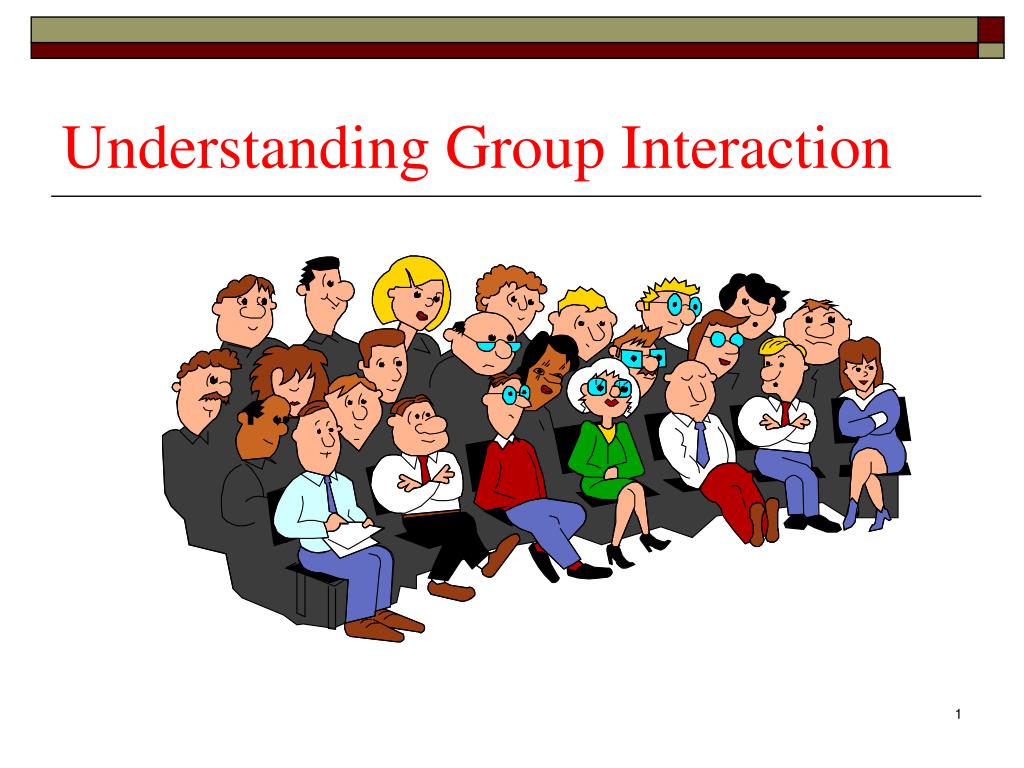
  1. Understanding Group Interaction

  2. What is a Group? • Multiple members • 2 or more people • perceive themselves as a group • Group rewards • Corresponding effects • Common goals

  3. Psychological Needs Affiliation Identification Survival Needs Emotional support Assistance or help Commonality Common interests Common goals Situational Reasons Physical proximity Assignment Why People Join Groups

  4. Factors Affecting Group Performance • Group Cohesiveness • Communication Structure • Group Roles • Presence of Others • Type of Task • Individual Dominance • Groupthink

  5. Factors Affecting Group Cohesiveness • Group Homogeneity • Homogeneous • Heterogeneous • Slightly heterogeneous • Stability of Membership • Isolation • Outside Pressure • Group Size • Group Status

  6. Group Homogeneity Research

  7. Group Size • Smaller is best for cohesiveness • Performance depends on task type • additive tasks • conjunctive tasks • disjunctive tasks

  8. Communication Structure • Chains • Centralized • Circles • Open

  9. Group Roles • Task-Oriented • offering new ideas • coordinating activities • Maintenance-Oriented • encouraging cohesiveness • encouraging participation • Individual • blocking group activities • calling attention to oneself

  10. Presence of Others • Social Facilitation and Inhibition • mere presence of others • comparison of performance • evaluation apprehension • Social Loafing • effort won’t be noticed • free-rider theory • sucker-effect theory

  11. Individual Dominance • By the group leader • By a group member

  12. Groupthink can occur when the group: • is cohesive • is insulated from outsiders • believes it is infallible • it is morally superior • is under pressure to conform • has a leader who promotes a favorite solution • has gatekeepers who keep information from members

  13. Group versus Individual Performance • Groups • have higher quality decisions • are more risky • Individuals • are more creative • make a decision more quickly