Download
1 / 22
220 likes | 334 Vues
This piece delves into the concept of multiple intelligences and their impact on interpersonal relationships. We all have preferred ways of understanding information, which shapes our interactions with others. Through Howard Gardner's work on intelligences, including linguistic and bodily-kinesthetic, and Robert Sternberg's theories on creative, analytical, and practical intelligence, we explore why some people rub us the wrong way. By considering these learning modalities, we can gain insights into our feelings and preferences, ultimately enhancing our understanding of ourselves and our connections with others.

E N D
Intelligences and You What does this all mean?
Non amote, Sabidi(Sabidius), nec possum dicerequare(why). • Hoc tantum possum dicere; non amote.---Martial, 1.32 • I do not like you, Sabidius, nor am I able to say why. • I am able to say this much; I do not like you.
Do some people just rub you the wrong way, and you can’t figure out why? • Look at their modes of learning or intelligences and we might find the answer.
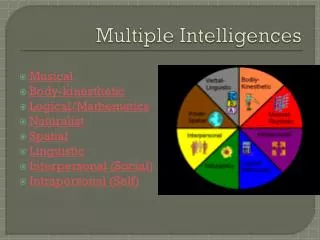
Garner’s work on Multiple intelligences states that all humans have a preferred way to relate and understand information. One area is predominant with all areas being represented in some fashion.
Linguistic Intelligence • Highly auditory • Likes to read, write, and listen • Has a good memory for names, dates, places • Has a well-developed vocabulary • Likes to play word games
Logical-Mathematical • Needs order • Likes to explore patterns, categories, relationships • Likes to make lists • Likes math and problem solving, crossword puzzles • Likes to win
Musical • Sensitive to sounds in the environment • Enjoys listening and playing music • Likes to collect music • Often taps and hums • Needs to express rhythms inside of himself/herself
Bodily-Kinesthetic • Needs to move around constantly • Uses body movement to learn • Often twitches, fidgets, and taps • Likes sports and active activities • Likes hands-on activities
Intrapersonal • Has awareness of inner strength • Has great self-esteem and confidence • Strong willed and deeply opinionated • Likely to take a controversial stand on a topic • Don’t invade my world • Doesn’t fit the norm=marches to a different drum
Interpersonal • Needs to interact with people • Inspired by others • Has many friends • Wants to organize, communicate, and provide harmony in a group • “I feel your pain” • Likes cooperative group work
spatial • Sees pictures, not words • Likes art activities • Likes movies, slides, and photographs • Easily reads maps, charts, diagrams • Likes jigsaw puzzles • Daydreams frequently
Robert Sternberg and Elena Grigorenko in 2000 developed a theory of intelligence falling into 3 areas: • CREATIVE • ANALYTICAL • PRACTICAL
CREATIVE PEOPLE • Find a new way to demonstrate knowledge • Imagine how life could be if……. • Discover new ideas if…….. • Create new ways to …………
PRACTICAL PEOPLE • Want to apply knowledge to solve a problem • knowledge is to help people’s problems • Want to develop a comparison between old and new information
ANALYTICAL PEOPLE • Must explain why • Identify key parts and they “fit” together • Compare and contrast the old with the new
LEARNING MODALITY • Kinesthetic • Work with hands in putting together or taking apart • Learn via movement • Hands-on applications • Tactile learners
Oral • Discuss with others your ideas • Read aloud to say the words • Love to talk about a topic
Visual • Love graphic organizers, charts, or diagrams for thoughts • Visualize characters and information • Write down your thoughts or notes
Auditory • Sounds connect you to information • Listen to texts or stories helps for understanding • Prefer to listen to a discussion than to participate
bibliography Learning Differences: Effective Teaching with Learning Styles and Multiple Intelligences. 2nd edition. Laureate Education: Los Angeles, 2000, 44-49, 124-126. Print.