Understanding the U.S. Constitution: A Comprehensive Overview
80 likes | 206 Vues
This brief guide outlines the essential components of the U.S. Constitution, including the roles of the legislative, executive, and judicial branches, as well as the process of amendments and the supremacy of federal laws. It highlights the structure and functions of Congress, the election and powers of the President, and the importance of the Bill of Rights. Additionally, it explores federalism and the relationship between states and the federal government, emphasizing the principles that guide the Constitution's application and interpretation.


Understanding the U.S. Constitution: A Comprehensive Overview
E N D
Presentation Transcript
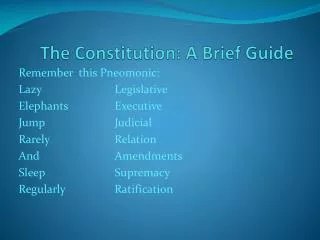
The Constitution: A Brief Guide Remember this Pneomonic: Lazy Legislative Elephants Executive Jump Judicial Rarely Relation And Amendments Sleep Supremacy Regularly Ratification
Legislative • Made of two parts • House of Representatives (Based on population) • Senate (2 per state) VP is president of the Senate Power to collect taxes and borrow money on the credit of the United States
Executive • How a President is elected • Term limits • Paid for the job and Commander in Chief • Order of succession if the President dies in office • Pres • Vice Pres • President pro temp of the Senate • Secretary of State • Secretary of the Treasury
Judicial • The Supreme Court is the Highest Court in the land • Rulings of the SC must be followed by lower courts • Person is tried in the state where the crime was commited. • Treason defined by someone waging war against the US, only the traitor gets the death penalty, not traitor’s family.
Relation (AKA Federalism) • New States can be created by Congress, not under control of any other states • Federalism-relation between states and between States and Federal Government • Separate and equal • Honor debts and borrow money from each other • Return fleeing criminals to stand trial
Amendments • One of the most important parts of the document • Amendments or changes of Con, happen when 2/3 of the house propose one, and ¾ of the states approve it. • Ratified in a reasonable amount of time • Bill of Rights first 10 amendments to the Constitution
Supremacy • All debts (i.e. Revolutionary War) will be repaid before Con is ratified • Federal Govt is more powerful (Supreme) than state govts. • Federal Laws trump State Laws
Ratification • Nine out of thirteen states had to ratify (legally allow it to take affect) • Unanimous ratification • Ratified Sept 17th 1787 Signers from NC William Blount Hugh Williamson Richard Dobbs Spaight