Project Connect: Lessons in collaboration
Project Connect aims to develop a comprehensive regional high-capacity transit system for Central Texas, acknowledging the need for coordination among various transportation agencies. This long-range plan emphasizes multimodal solutions to meet future transit needs and addresses critical questions regarding system functionality, organization, and funding. Community engagement and collaboration among stakeholders have been integral to the project, leading to a deeper understanding of transit dynamics and the importance of partnerships. Lessons learned emphasize the complexities of coordination and the necessity of sustaining momentum throughout the project.
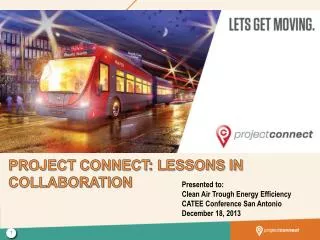

Project Connect: Lessons in collaboration
E N D
Presentation Transcript
Project Connect: Lessons in collaboration Presented to: Clean Air Trough Energy Efficiency CATEE Conference San Antonio December 18, 2013
Project Connect: Why? • Capital Metro jurisdiction, and prior planning efforts, did not encompass entire region • Community feedback on transit projects: “How does this fit in with big picture?” • Growing recognition that region requires multimodal system, including transit, to meet future needs • Need for agency coordination
Project Connect • A partnership between Central Texas transportation agencies • A regional, long-range high-capacity system plan for Central Texas • The firstregional transit system plan in Central Texas history
Three main questions • System: How will high capacity transit components in CAMPO 2035 plan work as a system? • Organization: How will our region organize to develop and operate the system? • Funding: How will we pay for the system over the long term?
Project Connect Organization • Staff level- formed core team and weekly meetings • Mid to senior and exec. level staff • Intermittent participation by transit CEO and Asst. City Manager levels • Interlocal Agreement developed to guide decision-making and funding actions • Consultant team hired for project • Substantial public outreach effort
Transit Working Group • CAMPO subcommittee • Primary stakeholder group in the Project Connect process • 26 meetings over past 18 months! • Role: Evaluate and provide input on a regional high-capacity transit plan for Central Texas
Project Development Process Regional Plan System Plan Corridor Studies Preliminary Design/Environmental Analysis Final Design Construction Operation
High-Capacity Transit • “Congestion resistant/proof” • Has one or both of the following: • Dedicated lane/right-of way for at least a portion • Transit priority • Fewer stops, higher speeds, more frequent service, carries more people
Vision Map • 25 Centers & ABIA • 4 Counties/13 Cities • Bastrop: Elgin • Hays: Buda, Kyle, San Marcos • Travis: Austin, Manor, Pflugerville • Williamson: Cedar Park, Georgetown, Hutto, Leander, Round Rock, Taylor
System FUNDING plan • By 2030 • Capital Cost - $1.9 B of $4.0 B • Capital Maintenance - $424 M • O&M Cost – $82 M of $151 M • 49% of the Vision • BRT – 15 miles • Express Bus – 56 miles • Regional Rail – 74 miles • Commuter Rail – 32miles (upgrades, double tracking) • Urban Rail – 12miles (24 miles single track) • Maintenance Facilities, fare collection, replacement vehicles
System Organization & Relationships Lone Star Rail District* Capital Metro City of Austin Other Investor-Owners • 1. Regional services focus • 2. Non-political governance • 3. Scalableand adaptable • 4. Urbanandcommuterservices included • 5. Seamless functionality– “single system” • 6. Planningfor all modes Integrated System Mgt. Regional Service Committee System Planning & Business Ops. BRT & Express Bus Operations Other Capital Investment Ops. Rail Operations *Relationship will need to accommodate LSRD inter-regional service delivery and internal governance structure.
Three main questions • System: How will high capacity transit components in CAMPO 2035 plan work as a system? • Organization: How will our region organize to develop and operate the system? • Funding: How will we pay for the system over the long term? All answered…at the system level
Project Connect: Capital Metro Perspective • Lessons Learned: • Recognition that partnerships are only way to realize vision of regional transit system • ‘Leap of faith’ to actively study/plan beyond jurisdictional boundary • Compromise and trade-offs required, but not always welcomed • Funding remains as a major challenge
Project Connect: City of Austin Perspective • Lessons Learned: • Citizens do not understand who is responsible for services • Public Agencies must continuously work on their relationships and develop mechanisms to resolve conflicts • City shaping or serving current riders
Transit Working Group • CAMPO subcommittee • Primary stakeholder group in the Project Connect process • Lessons Learned: • Engage key elected and stakeholders early and often • People support what they help create • Simplifying complexity is hard work- needs to be done carefully • Be mindful not to let ‘the tail wag the dog’ • 26 meetings over past 18 months! • Role: Evaluate and provide input on a regional high-capacity transit plan for Central Texas
Project Connect Summary • Lessons Learned: • Partnerships are hard work • Coordination meetings essential, despite the pain • Personalities, not just inter-jurisdictional differences, can be the make or break element • Open dialogue is critical…but not always what happened • Maintaining momentum post-study essential for long-term success
Questions and Discussion Rob Spiller, P.E. Director City of Austin Transportation Department Javier A. Argüello, Assoc. AIA, CNU-A Director Long Range Planning Capital Metro