Exploring Oscillators: From Linear Restoring Forces to Nonlinear Dynamics
110 likes | 218 Vues
This article delves into the fascinating world of oscillators, focusing on equations of motion (EOM) and their integration to describe parabolic trajectories. We start with linear restoring forces and hypothesize solutions using simple harmonic motion (SHM), then transition to nonlinear restoring forces, exploring the use of Taylor series expansions. The interplay between spring forces, stable equilibrium points, and the Ideal Gas Law elucidates the complexity of dynamic systems. We also discuss the implications of small perturbations and how to linearize EOM effectively around stable equilibria.


Exploring Oscillators: From Linear Restoring Forces to Nonlinear Dynamics
E N D
Presentation Transcript
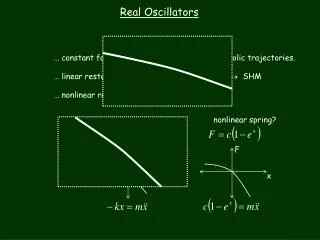
Real Oscillators … constant forces integrate EOM parabolic trajectories. … linear restoring force guess EOM solution SHM … nonlinear restoring forces ? nonlinear spring? linear spring F F x x
0 0 The spring of air : use Ideal Gas Law: PV=NRT Patm chamber volume: V=Ax WTF! (whoa there, fella) m EOM A +x Stable Equilibrium at xeq = NRT / (mg + APatm) P, V 0
Taylor Series Expansions: Turns a function into a polynomial near x = a Example:
Expand around x = -3: 2nd order 0th order 1st order
Expand around x = 2: 0th order 1st order 2nd order
Expand NRT/x around xeq: Is it safe to linearize it? Better check a unitless ratio. How about: (Yes, excellent choice Dr. Hafner!)
.. Displacement 5% of xeq: 0 .05 .0025 …. Perhaps you would prefer…. SHM with
-x Simple Pendulum: Stable Equilibrium: Length: L Mass: m Q Displace by Q: mg cosQ T mg cosQ sinQ mg cosQ EOM: mg Expand it! mg
Now express as a unitless ratio of the dependent variable and some parameter of the system: Displacement 5% of length: 0 .05 0 .0000625 … SHM with
The world is not linear. However, one can use a Taylor expansion to linearize an EOM by assuming only small perturbations around a point of stable equilibrium (which may not be the origin).