Benjamin Franklin and the Social Landscape of Colonial Philadelphia
In 1750, Benjamin Franklin emerged as a key figure in Philadelphia, leading initiatives to cultivate useful knowledge through the American Philosophical Society. Despite a more egalitarian social structure compared to England, social classes such as gentry and middle class were prominent. The middle class comprised three-quarters of white colonists, while women performed essential household roles and worked in various trades. This period also saw the influence of African cultures and the Great Awakening, which spurred religious fervor and a push for education across the colonies.

Benjamin Franklin and the Social Landscape of Colonial Philadelphia
E N D
Presentation Transcript
The Colonies in 1750 Chapter 4, Section 5
Ben Franklin a leading citizens in Philadelphia invited colonist to join a society that promote useful knowledge • The American Philosophical Society as born
Social Classes • Colonists enjoyed more social equality than people in England did. • However classes still existed • Gentry: wealthy planters, merchants, lawyers and royal officials • Middle class: farmers who worked their own land, skilled crafts workers, and some trades people • 3/4of all white colonist belonged to the middle class
Social Classes • Indentured servants: promised to work without wages for four to seven years for whoever would pay their ocean passage to the Americas • When their term was over they received “freedom dues,” set of clothes, tools and 50 acres of land
Women in the Colonies • Took care the household, her husband, and family • Cooked, milked cows, watched children, and made clothing • In cities a young single women from a poor family might work as a maid, a cook, or a nurse for a gentry
Women in the Colonies • Others worked as midwives or sewed • Women sometimes learned trades from her father, brothers, or husband • Shoemakers, silversmiths, and butchers
African Cultural Influences • Culture of Africans in the colonies varied greatly • Rice plantations in South Carolina slaves saw few whites • African customs remained strong
The Southern colonies • In port cities like Charleston more than half the population was black. • Worked along the docks making ropes, barrels, or helping to build ships • In Virginia and Maryland African traditions were weaker • Less isolated from whites
The Middle and New England Colonies • Fewer Africans lived here
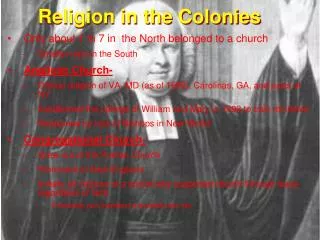
A Renewal of Faith • Great Awakening: religious movement in the 1730s and 1740s • Jonathan Edwards: a New England preacher set off the Great Awakening • Called on colonists to examine their lives • Warned listeners that unless they heeded the Bible’s teachings “they would be sinners in the hands of an angry God’
A Renewal of Faith • 1739 George Whitefield, an English minister, arrived in the colonies • Drew huge crowds • He spoke with passion and feeling as he called on sinners to reform
A Renewal of Faith • Supports of the Great Awakening often split from churches and formed new ones • The growth of new churches forced people to become more tolerant of people with different religions
Concern with Education • New Englanders were most concerned about education • Puritans believed people had a duty to study the Bible • So they need to learn how to read
Public Schools in New England • 1647 Massachusetts assembly passes a law ordering all parents to teach their children to read and understand the principles of religion • All towns with 50 families to hire a school teacher • Towns with 100 families had to set up a grammar school to prepare boys for college
Public Schools in New England • Public school: school supported by taxes • Massachusetts set up the first public schools • On e room for all students of all ages • Parents paid the teacher with corn, peas, or other food • Each child was expected to bring a share of wood to burn in the stove
Middle and Southern Colonies • Middle colonies • Churches and individual families set up private schools • Pupils paid to attend • Only wealthy families could afford to educate their children
Middle and Southern Colonies • Southern Colonies • Families lived to far apart to bring children together in one building • Some planters hired tutors • Wealthiest planters sent their sons to school in England • Slaves were denied education of any kind
Learning by doing • Apprentice: worked for a master to learn a trade or craft • Ex. Glassmaker, papermaking, printing
Education for girls • In New England some girls attended dame schools, or private school s, ran by women in their homes • Most school in the colonies accepted only boys • Girls learned from their mothers
An Age of Reason • European scientist tried to use reason and logic to understand the world • Developed theories and performed experiments to test them • Ex. Isaac Newton’s force of gravity
An Age of Reason • European thinkers tried to use the same principles to study society • They tried to discover natural laws to govern human behavior • This movement became known as the Enlightenment
Benjamin Franklin • Born the son of a poor soap and candle maker • Strong believer in self improvement • Had only two years of schooling • Used his spare time to study literature, mathematics, and foreign languages • Became an important colonial leader
Benjamin Franklin • In Philadelphia he started a successful printing business • Published poor Richards Almanac
Benjamin Franklin • Franklin proved that lightening was a form of electricity • Flew a kite during a thunderstorm • Bolt of lightning struck wire fastened to the kite and caused a spark
Benjamin Franklin • He convinced Philadelphia to pave streets and to organize a fire company • He and leaders set up the first lending library