
SlideServe
Menu
Préférences
© SlideServe · v2026

Financial Aid Programs for Low-Income Students: Carolina Covenant, Pack Promise & More
badrani avatar
20 diapositives · 342 Views · Aug 08, 2014

Discover the financial aid programs designed to support low-income students in North Carolina, including the Carolina Covenant at UNC-Chapel Hill, which assures debt-free graduation for students below 200% of the federal poverty level. This program provides grants, scholarships, and work-study opportunities without loans. Learn about NC State’s Pack Promise, offering full funding for students from families earning below 150% of poverty level, and other initiatives like the Greensboro Guarantee and UNCW's SOAR program, which assist students in achieving academic success.
Financial Aid Programs for Low-Income Students: Carolina Covenant, Pack Promise & More - slide 1
01 / 20Financial Aid Programs for Low-Income Students: Carolina Covenant, Pack Promise & More
1 / 17

Télécharger la présentation

Financial Aid Programs for Low-Income Students: Carolina Covenant, Pack Promise & More
Une image / un lien ci-dessous est fourni (tel quel) pour télécharger la présentation

Politique de téléchargement : le contenu du site vous est fourni TEL QUEL pour votre information et votre usage personnel ; il ne peut être vendu, concédé sous licence ni partagé sur d’autres sites sans l’accord de son auteur.Le contenu vous est fourni TEL QUEL, pour votre information et votre usage personnel uniquement. Téléchargez la présentation en cliquant sur ce lien. Lors du téléchargement, si vous ne parvenez pas à télécharger une présentation, l’éditeur a peut-être supprimé le fichier de son serveur.Pendant le téléchargement, si vous ne parvenez pas à obtenir une présentation, le fichier a peut-être été supprimé par l’éditeur.

F I N

Plus de contenu associé

Transcription de la présentation
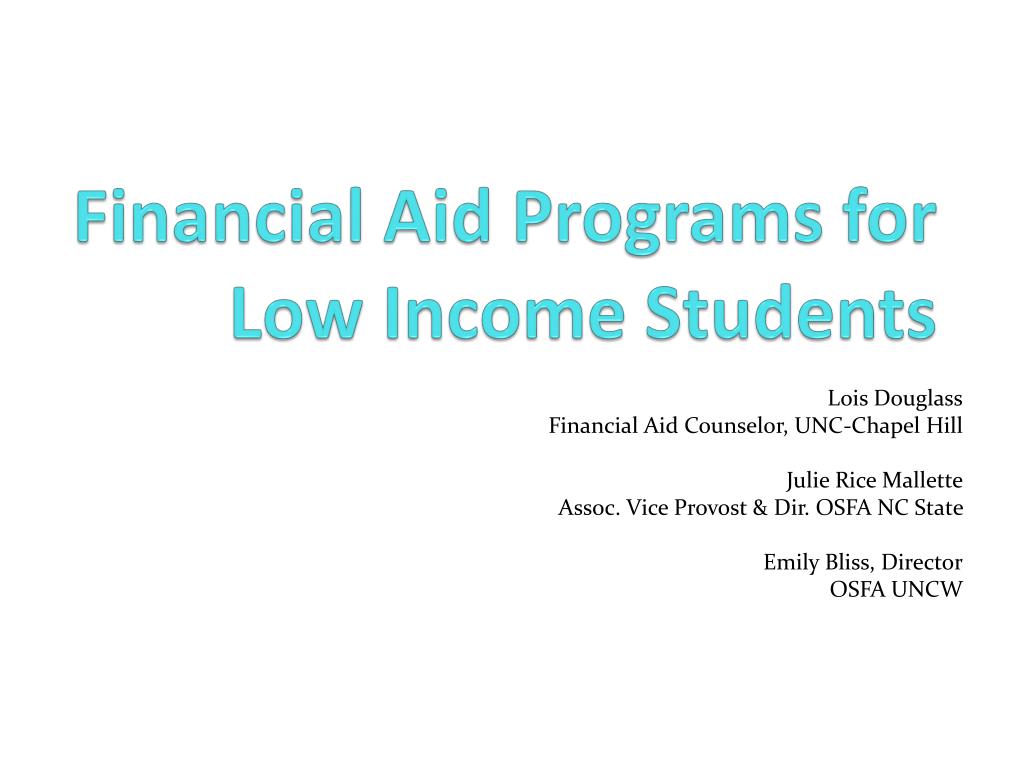
  1. Financial Aid Programs for Low Income Students Lois Douglass Financial Aid Counselor, UNC-Chapel Hill Julie Rice Mallette Assoc. Vice Provost & Dir. OSFA NC State Emily Bliss, Director OSFA UNCW

  2. The Carolina Covenant • What is It? • Announced in 2003, but first entering class in 2004-05. • A promise for students to graduate debt-free who are at or below 200% of the federal poverty guidelines. • Meet 100% of need with grants, scholarships, work-study, no loans. • Receive a laptop grant. • Summer Orientation fees and housing on campus for student and one parent. The University of North Carolina at Chapel Hill

  3. The Carolina Covenant • Poverty Guidelines The University of North Carolina at Chapel Hill

  4. Characteristics of Covenant Scholars* [*] The income threshold for consideration for the Carolina Covenant was initially established at 150% of federal poverty guidelines. Starting in fall 2005, it was increased to encompass students with parents’ adjusted gross income up to 200% of the federal poverty standard.

  5. Characteristics of Covenant Scholars, cont. Fall FallFallFallFallFall 2004 2005 2006 2007 2008 2009 Average Parental Income First Year Scholars $18,428 $22,967 $22,484 $23,972 $22,913 $26,026 All Covenant Scholars $23,086 $24,551 $25,856 $26,716 $27,744 Average Expected Family Contribution First Year Scholars $ 769 $ 1,221 $ 1,060 $ 951 $ 910 $ 681 All Covenant Scholars $ 1,415 $ 1,508 $ 1,469 $ 1,505 $ 1,079 Percentage of Award by Type of Assistance (All Covenant Scholars) Grant 91.2% 88.8% 86.7% 87.2% 86.9% 93.1% Loan 3.2 5.41 7.2 7.1 8.3 5.0 Work Study 5.6 5.9 6.1 5.6 4.7 1.9 Percentage of Award by Source of Assistance (All Covenant Scholars) Federal 40.5% 36.0% 35.1% 35.6% 35.5% 30.4% State 13.4 18.9 17.8 18.9 21.0 28.6 Institutional/Other 46.1 45.1 47.1 45.5 43.5 41.0 Fall 2009 data as of December 1, 2009, Office of Institutional Research and Assessment

  6. The Carolina Covenant • More than Financial Aid • Summer Orientation for students and parents • Faculty Mentoring Program • Peer Mentoring Program • Programming for students through Learning Center, Career Services, Memorial Hall, Medical School, Student Advisory Board • Academic counseling – monitoring grades, and intrusive contracts for summer restoration of grades The University of North Carolina at Chapel Hill

  7. The Carolina Covenant • Other Access Initiatives and websites • Covenant Website: http://www.unc.edu/carolinacovenant/ • Access Initiatives Clearinghouse: http://studentaid.unc.edu/pdf/misc/CollegeAccessInitiatives.pdf • Poverty Guidelines: http://aspe.hhs.gov/poverty/09poverty.shtml • Development Office support – major fund raising campaigns for support programs. The University of North Carolina at Chapel Hill

  8. NC State’s Pack Promise • Approved by the Board of Trustees in April 2006 • Communication Plan • www.ncsu.edu/packpromise

  9. NC State’s Pack Promise • Meets 100% of need for up to 9 semesters for students from families with incomes at or below 150% of poverty level. • Parents must not have significant assets (less than $100K) • Not a debt-free commitment • Provides mentoring and academic support in addition to funding

  10. NC State’s Pack Promise • Numbers of New Students Funded Per Year: • 2006-07 – 315 • 2007-08 – 319 • 2008-09 – 332 • 2009-10 – 285 • Cumulative Total Pack Promise Scholars Per Year • 2006-07 – 315 • 2007-08 – 576 • 2008-09 – 833 • 2009-10 – 1058 (enrolled for fall 2009 as of 8/31/09)

  11. NC State’s PackPromise • 91% NC Resident (compared to 89% of all FR) • 9% Non-Resident (compared to 11% of all FR) • 53% Male (compared to 53% of all FR) • 47% Female (compared to 47% of all FR) • Ethnic Diversity of Pack Promise Scholars • Enrolled Ethnic Group • Number (based on fall 09 ethnic enrollment data) • Caucasian 494 2.8% • Native American 15 12.4% • African American 328 16.7% • Asian 112 9.5% • Hispanic 68 10.1% • Unknown/Multi 41 4.3%

  12. Greensboro Guarantee • Implemented for first time in 2010-2011 • Individual academic success plan to be developed for students • Full time academic advisor assigned to cohort • Will keep them on track to graduate in 4 years • Will meet with students 3 to 4 times per semester

  13. Greensboro Guarantee Services to be offered • Tutoring • Mentoring from within the Greensboro University and the surrounding community • Workshops on study skills, time management, money management, etc.

  14. UNCW’s SOAR • 200% of Poverty • 2.5 GPA • Verification • Opportunities for Non-Financial Aid Programs • Graduated Increments of Grant Funding • Desired Outcomes

  15. UNCW’s SOAR • Tried to run as a financial aid program only • Awarded too late in the year • Were not able to keep loans as low as we would have liked • Not as many students in the 200% range as we had expected • Had difficulty tracking due to time

  16. UNCW’s SOARRevamped Program • Still at 200% poverty • Will contact upon admission for freshmen • Base amount will be $3000 • Students can receive more if they participate in different programs • Job Shadowing • GPA 3.0 • Leadership activities • Work or volunteer

  17. UNCW’s SOARRevamped Succeeded in getting buy-in from other offices • Tutoring Lab • Counseling Center • Center for Leadership • Advising (freshmen seminar) • Dean of Students • Diversity Office

  18. UNCW’s SOARRevamped Financial Aid will • Award Funds • Track academic success of students • Track involvement of students • Meet with students at least once a year • Survey students to see what works and what doesn’t • Try to get more funding

  19. Working with funds you have • Identify an amount of current funding and direct it to a single cohort • Ask for funding from your budget office, then ask again, and then again. Do not stop until they give you some to keep you from asking • Ask your Advancement Office for help • Do not give up. Sometimes this takes years.

  20. Questions